How Much Can You Earn in Traffic Arbitrage — Up-to-Date Information for 2026

Every year, the traffic arbitrage market continues to grow: experienced arbitrage teams expand, new ones emerge, fresh products are launched every month, and conferences gather thousands of attendees and hundreds of projects. And in the background, the idea that making big money here is easy and fast is constantly being broadcast...
But the current situation is very different from what it was just a few years ago. Let's break down how the market has changed and how much a traffic arbitrageur can earn today.
How much can a beginner earn in traffic arbitrage?
For the last couple of years, the entry ticket to traffic arbitrage for most beginners was the "first bill" (first billing). Almost all blogger training courses were built on abusing this mechanic, where a beginner could start with literally a hundred dollars and quite quickly reach an income of a couple of thousand dollars.
The scheme is that Facebook Ads, like most advertising networks, works on a post-pay format: it deducts money from the card after showing the ads, upon reaching a certain billing amount. You can launch ads "in advance," get a small volume of traffic, and not pay for it — this is what is called the "first bill."
Scaling occurred by launching tens or hundreds of advertising campaigns per day. To work, it was enough to have an antidetect browser, inexpensive accounts, and special cards for advertising with a minimal balance, which are sold in various shops. Previously, Facebook could set the first billing at $10 or $25, which made it possible to get a serious volume of "free" traffic by launching a hundred accounts. Even with a zero conversion rate, the arbitrageur made a profit — equal to the spend in the statistics, leaving only the minor expenses for accounts and virtual cards to be deducted.
Now this scheme has lost its relevance due to the increased cost of the launch process, the first billing dropping to $2, and the introduction of a billing amount "freeze" even before the ads are launched.
As for the classic scheme of working with traffic, little has changed except for profit margins: with the growth of competition and traffic volumes in the market, the final profitability continues to fall. Over the last year, the ROI of a large team averages 30-40%, while a very good result is 40-60%. Some days can still bring 100%+, but if you look at the month as a whole, the metric evens out.
Earnings in an arbitrage team
Conditions in teams also remain the same: a beginner in traffic arbitrage receives a fixed base salary of around $500 and a percentage of the net profit. The percentage "ladder" starts at 15% and can go up to 50% — the scale is progressive and depends on the volume of profit generated.
If you made $3000–5000 in profit in a month, the final salary will be approximately $1100-$1500. Accordingly, if the profit was around $10000, you will receive about $2500. It should be noted that different teams may have different ways of calculating the percentage part:
1) From profit after deducting all expenses 2) "By the tracker" — revenue minus spend 3) With payment for creative expenses or partial payment for other tools
We recommend not chasing a high percentage, but looking at the real results in the team and its capabilities: technical infrastructure, creative department, offers — what conditions the team gives you, and how much profit you can make within it. They might promise 50% of the net profit, but if you have to independently look for offers, make creatives, handle integrations, sort through accounts, and so on (essentially spending a significant part of your time on organizational issues), then the volume of traffic and final earnings will be significantly lower than in teams where a buyer gets 30% but deals exclusively with traffic, while the team quickly and efficiently solves the rest of the tasks.
There is practically no salary ceiling in traffic arbitrage — it depends on the skills of finding profitable campaign combinations and scaling. Everything one way or another comes down to a large volume of work. But it is rare that even a senior buyer who generates tens of thousands of dollars in profit is given a high base salary: the foundation of the income structure has always been a percentage of the profit, and the fixed part does not exceed $1000-2000. Key employees and team leads can receive personalized conditions — a higher base rate, a percentage of the team's income. The logic is always maintained: if there is profit, there is a high salary; if there is no profit, the team at most covers basic needs.
Nevertheless, qualified media buyers can relatively stably earn around $10000 and above.
If we take an average specialist with experience (a nominal middle media buyer), the average monthly salary is around $3000-5000. It must be understood that traffic arbitrage is a dynamic environment with high risks and turbulence. For one or two months, running traffic goes well, then there is a drop in traffic for a month or more, then a recovery again, and a decrease in volumes again — and so on in a circle. Accordingly, the salary will also jump from month to month: $10000, a near-zero month or with a salary of $1000-2000, a rise again, and a reduction in profit again.
Now there are practically no public mass stories of super-profits. The market is highly competitive, and if a new approach appears, it is scaled and squeezed to the maximum without loud words, earning money until competitors have mastered it.
It can be said that today, earnings in traffic arbitrage for ordinary specialists are similar in salary to classic IT in the international market. And while IT is more stable, in traffic arbitrage many love the dynamism — you can earn quickly and a lot on some trending topic, or you can hit a period when everything gets banned, there are no conversions, and the market is full of despair — simply wasting time, money, and giving up.
Should a beginner try to make money in traffic arbitrage?
Beginners need to take off their rose-colored glasses and look at this field objectively: you will have to work a lot, but you can start from scratch without deep knowledge and quickly reach at least a minimal result. The market is always looking for fresh, ambitious personnel who are hungry for money, and willingly gives them opportunities: hundreds of teams are ready to invest in an employee.
If you look at polls in author-run Telegram channels, they show that 75% of the media buyer market earns up to $5000. At the same time, there is a noticeable share of those who have reached an income of more than $10000. You shouldn't take such polls as absolute truth, but the numbers are close to reality.
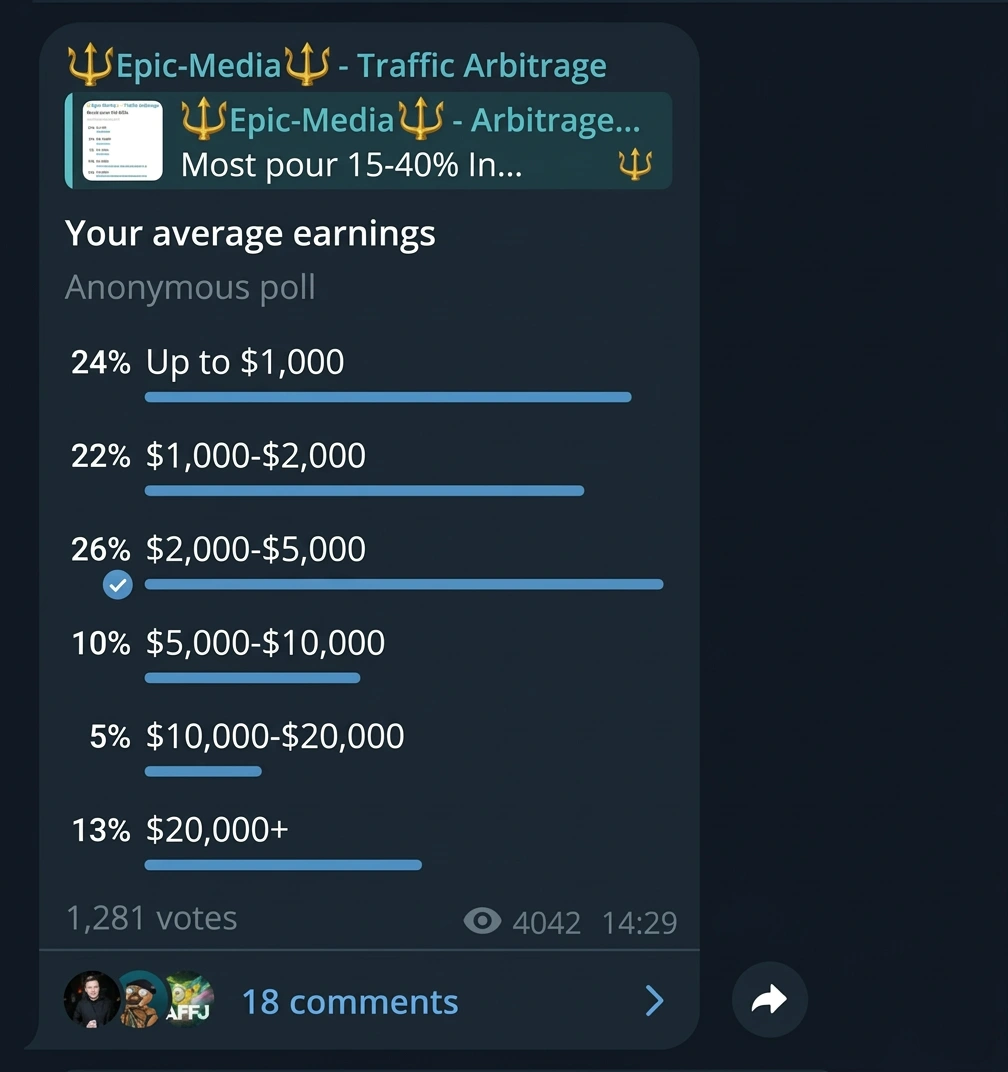
It is important to understand that today you can make big money in traffic arbitrage only by fully dedicating yourself to the process and building a system. You won't be able to make a profit for months on a single campaign combination; you need to scale aggressively and constantly look for new approaches to create at least some stability for yourself.
If you just want to start your journey in traffic arbitrage, the easiest option is to get practice in a team, starting from an entry-level position as a farmer or buyer's assistant. Often, basic theoretical experience is enough for this. All the information today is available on the internet, as well as in Telegram channels for free.
Working solo, even at the start, requires a budget of a couple of thousand dollars, without any guarantees of success. Starting to work with paid traffic without experience using your last or borrowed money is a deliberately losing position. It is better to figure out the options for obtaining and monetizing conditionally free traffic, or still try to get into a team to build basic experience.
The key difference in earning from traffic arbitrage compared to classic IT is that you need to be constantly involved in the process and solve various creative tasks. Despite established processes, finding a new campaign combination requires new experience, which is complicated by constantly changing algorithms in various traffic sources. But someone who is sincerely involved in the process, persistent, and hardworking can reach an income of more than $10000.