Which proxies to buy for work - 10 best proxy services

Stable and scalable online earnings inevitably involve working with proxies. Their quality, along with the correct substitution of your antidetect browser's digital fingerprints, determines the likelihood of bypassing platform anti-bot systems and the feasibility of multi-accounting without bans.
We explain in simple terms what a proxy is, what type of tasks each kind is used for, as well as who the current market leaders are and at what prices they offer their services.
What is a proxy in simple terms
A proxy server is an intermediary for safe internet access. If you are a beginner, the simplest description is: a proxy is a kind of VPN that allows you to change your IP address to bypass various restrictions and protect your internet connection.
Every device, when interacting with an external server (visiting a site, app activity, messaging), sends a request using the data of the device's current internet connection – it sends the server your real IP address provided by your ISP or mobile operator. Interaction format: you – server. Data exchange happens directly.
Using a proxy, your request first goes to the proxy server, an intermediate server through which all your traffic passes, sending data to the target resource's server (the website) on its own "behalf". That is, if a proxy server is used in your internet connection, the final resource receives its data, not the real connection data of your device.
For example, if you use a German proxy IP address, the site will identify you as a user from Germany, regardless of where you actually are.
Why are proxies needed?
One of the main functions of a proxy is ensuring security by substituting the real IP address and location. When using an antidetect browser like Linken Sphere and a proxy connection, the user becomes anonymous online, a new device with unique digital fingerprints and an IP address that are in no way connected to the real device.
Speaking of practical application, proxies help bypass various platform restrictions, allowing you to scale workflows in many areas of online earnings.
Every internet platform sets interaction rules that do not allow maximizing process potential. A banal example: allowing a user to have only one personal account, and blocking or "flagging" new ones upon creation. Even if you unknowingly violated platform rules and got banned, this can ruin all your plans.
Specialists from absolutely different fields face similar situations: advertising agencies, marketers and media buyers, sellers on e-commerce platforms, specialists involved in data collection (parsing), bonus hunting, and other areas requiring many active accounts or process automation.
How does it work?
Platform anti-bot systems have data on the average user and their activity, which allows them to identify unwanted "anomalies" and fight them.
For example, you are collecting data from sites – automatically tracking prices in online stores in real-time to find the lowest ones and entering them into your table for further purchase for resale – you send hundreds of requests in a short time, which creates a load on the server from one IP address and forces the system to react. At best, you will receive a captcha in response, without passing which you cannot continue the process.
If you distribute the process through several proxy servers, the system will receive the same load volume, but not from 1 IP, but, say, from 20-30 unrelated IP addresses, which will look less suspicious and will not require sanctions against you (the situation is abstract, the number of requests is far from real).
Speaking of social networks, an "anomaly" can be spam or registering dozens of accounts in a short time. Upon detecting such activity, the anti-bot system will take measures – for example, block you. And with further violations, it can blacklist your IP address and device digital fingerprints, sending you to a preventive ban upon detection, even before violating platform rules.
By the same logic, you can bypass such restrictions using a proxy and an antidetect browser, where each new profile will be an absolutely independent device with its own "history".
It is worth noting that the presence of any proxy server does not guarantee a solution to the issue; they must also be chosen correctly for the task.
Types of proxy servers
Given the fact that almost any device with internet access can act as a proxy server, there are several types of proxies by origin: datacenter (server), residential, mobile.
Datacenter (Server) proxies are proxy servers running on the capacities of data centers, large cloud or physical equipment providers. They are relatively cheap, have high speed, but their IP addresses are "recognizable" (often identified by anti-bot systems as proxies) because they belong to large hosting providers like Amazon, Digital Ocean, Hetzner, etc.
Often used for technical tasks that do not require anonymity, where the consequences of identification are insignificant: parsing information, automating API work, implementing various scripts. Not suitable for working with social network accounts, advertising, platforms monitoring the uniqueness and "realism" of the user.
Residential proxies are IP addresses of real devices that they receive from their internet provider and act as a proxy server using special software. Security systems identify such IP addresses as user ones, not server ones, which guarantees a high level of trust in this user.
Their main area of application is multi-accounting. Used when working with many accounts in ad networks like Meta Ads, Google Ads, TikTok Ads, parsing data from marketplaces and platforms with a high level of protection. They are the main tool for anonymous connection and allow bypassing restrictions that datacenter proxies or VPNs may not solve.
It is worth noting the higher price compared to server proxies, good speed, and high level of anonymity.
Mobile proxies are proxy servers that use IP addresses of mobile operators. They are considered the most reliable option for tasks of any complexity. The specifics of mobile proxies are that they belong to mobile operators, whose end user is a mobile internet user, essentially every person. And if a service blocks the entire subnet of mobile operator IP addresses, it can block thousands of real users.
Based on this, mobile proxies are often used for tasks that require a maximally "real" device – working with social and advertising accounts, multi-accounting in marketplaces, dropshipping.
Given the fact that a real mobile operator SIM card is needed for mobile proxies to work, their cost is higher, speed is above average – depends on the mobile coverage of the mobile operator in a specific country.
What do IPv4 and IPv6 mean in proxies?
When choosing a proxy, besides different types, you can also find two protocol versions – IPv4 and IPv6. To avoid going deep into technical details, it is enough to understand that not all sites and platforms allow working correctly with IPv6 proxies, so if the task involves bypassing anti-bot systems and requires a high level of trust from your profile, it is better to use IPv4.
What is the difference? IPv6 is a new, more modern protocol type that solves one of the main problems of the IPv4 protocol – the finiteness of IP addresses. At the stage of technology creation, such internet coverage in the world was not planned, so the issue of scaling was not so acute. There are only about 4.3 billion IPv4 IP addresses, and almost all of them have already run out. But since this technology was universal, and most web resources were originally built to work with it, trust in this protocol type is higher. Accordingly, the price for IPv4 is higher than for IPv6.
We can say that now is a transition process to a new protocol type – IPv6, which means its market penetration is only a matter of time. IPv6 is often used for automation, development, parsing.
If you need to work with accounts in social and advertising networks, marketplaces – we recommend choosing IPv4.
How to choose a proxy server?
When choosing a proxy, the main parameter is the tasks you will solve with their help. We have already described the features of each proxy type, so in a nutshell and in simple language:
- Server (Datacenter) – cheap solution for automation, parsing, testing;
- Residential – universal solution for any tasks, used for multi-accounting on any platforms;
- Mobile proxies – universal, but more expensive, IP addresses of mobile operators.
The price difference between each proxy type is significant, so it makes no sense to solve parsing tasks using residential proxies, or try to save money and work with multi-accounting in Meta or Google with datacenter proxies.
The next parameter to pay attention to when choosing a proxy server is operation speed and connection stability. For the same cost from different providers, you can get absolutely different quality proxies. Good news: most proxy providers are happy to provide a trial in their service, which will allow basic testing of their proxies. If any service like speedtest helps with determining speed, then connection stability is better viewed directly during work – so that the connection does not drop in the middle of the workflow and you do not need to change the port or wait for a solution from service support.
A parameter that also plays a big role is the "cleanliness" of the IP address. You need to understand that the general pool of a proxy provider numbers tens, and sometimes hundreds of millions of IP addresses. Naturally, most of them have already been in use, and, most likely, listed in service blacklists. In turn, databases of "unwanted" IP addresses, like bot databases, are often exchanged to jointly filter out such traffic.
This means that even if you took an absolutely new IP address, it may already be blacklisted due to the background of the rest of the pool. All you need to understand here: proxies need to be tested for a specific task, a high price for a proxy can be justified by their "cleanliness", and pay off on tasks where a high level of trust from the anti-bot system is required, and where there is high margin.
The main parameter when choosing, of course, also includes the price. The user's task when choosing a proxy is to find the optimal solution in terms of "cleanliness", speed, and stability for the best price on the market. In the long run, this will save you a significant share of the budget.
How to check proxy performance?
Before working with target resources, you need to check the proxy connection and compliance with stated characteristics. To do this, you can use anonymity check services, for example Fake Vision, which checks the anonymity of your browser profile, the correctness of substitution, as well as your IP connection. Additionally, the service also shows the "quality" of the proxy – whether it identifies it as a VPN or proxy, or as a standard connection.
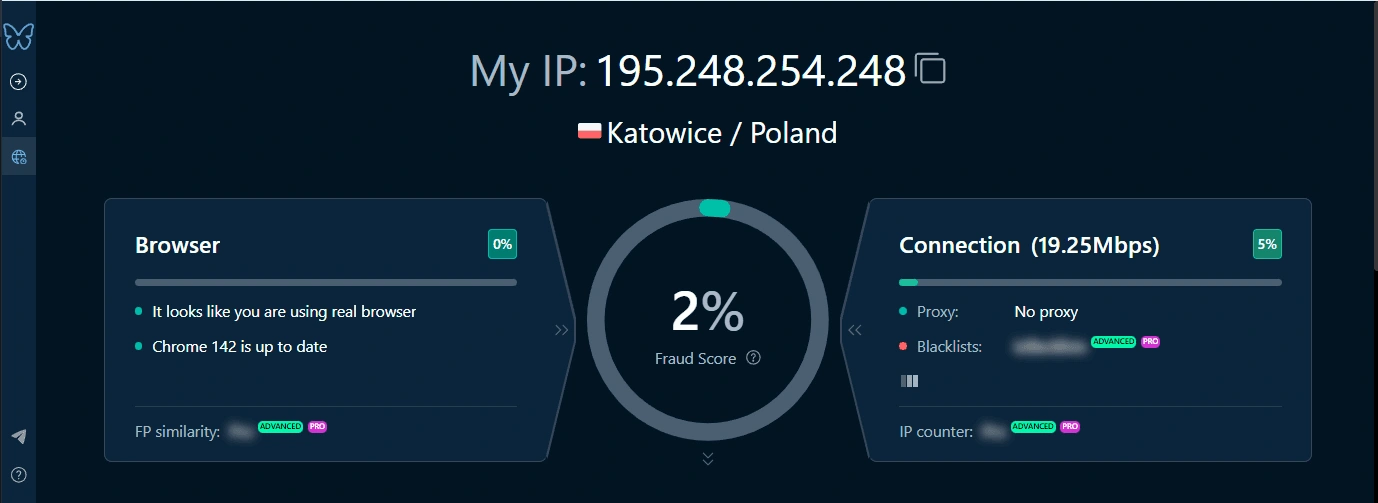
You can also use analogues – for example, pixelscan. But even if a proxy is in some blacklists, this does not mean you cannot work with it. Everything depends on the tasks, the level of the anti-bot system, and other factors (behavioral, trust in the session – account, cookies). Such services help avoid gross errors, and then there are details that can change from task to task.
10 best proxy servers for multi-accounting
Oxylabs
One of the largest proxy services specializing in parsing. Present on the market since 2015 and has over 177 million IP addresses covering about 195 countries worldwide.
The service offers clients all types of proxies with flexible payment options:
- residential proxies with pay-per-traffic at $8/GB, package formats with an average cost of $3.75 per GB
- server proxies at prices up to $1.6/month for 1 IP
- mobile proxies starting from $5.4/GB with pay-per-traffic, as well as package formats with an average cost of $4.75 per GB
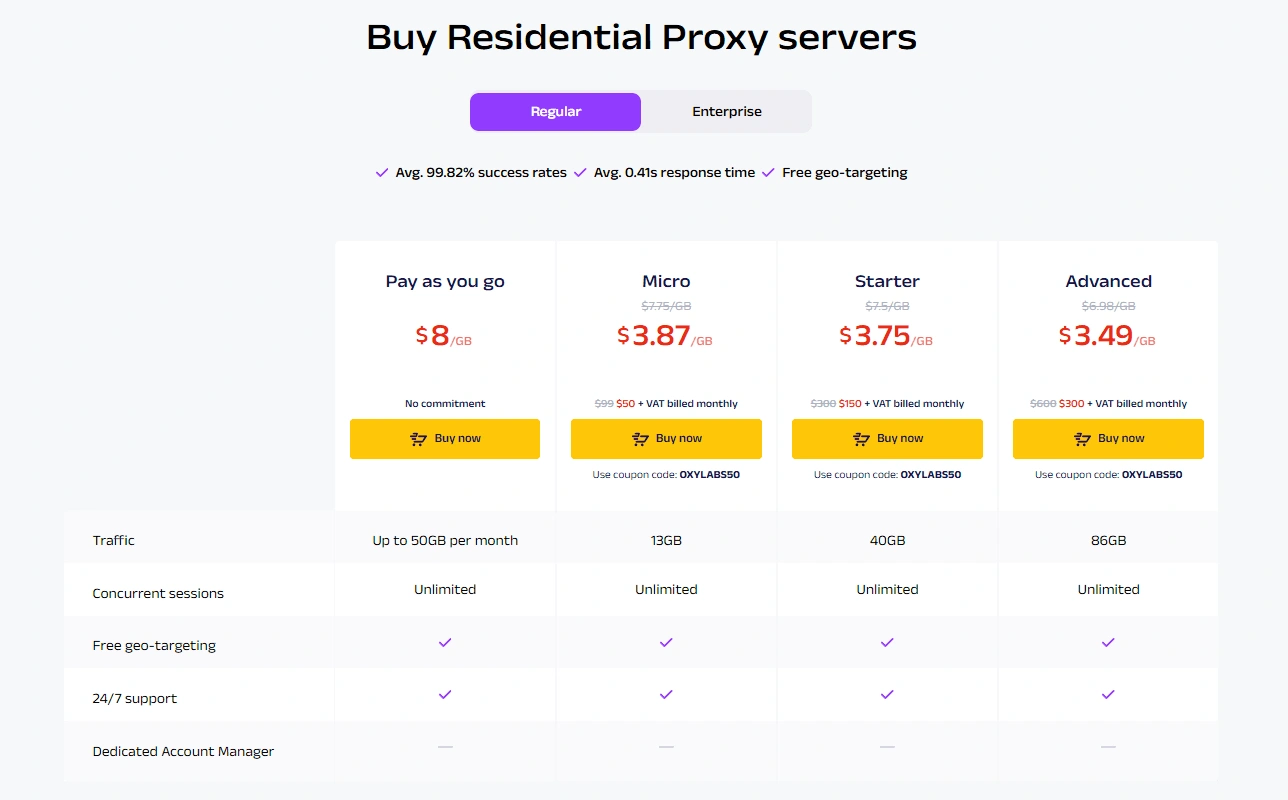
For companies and large clients, a special offer applies with prices 30-50% more profitable depending on the tariff and proxy type.
Oxylabs also offers a wide range of AI tools for web scraping and guarantees 24/7 support for all clients.
A 3-day trial is available for new users, as well as bonus promo codes. Payment is made using bank cards and transfers, PayPal, and other payment systems.
IPRoyal
A provider of global proxy solutions with flexible tariff plans. The service offers a set of proxy servers of all types with payment both by the Pay as You go system and by subscription system. The total pool of residential proxies numbers more than 32 million IP addresses.
Prices vary by proxy type, traffic volume, and payment model:
- Residential proxies – $2.57-3.68/GB
- Mobile proxies – $130/month
- ISP proxies – from $2.7 per month for 1 IP
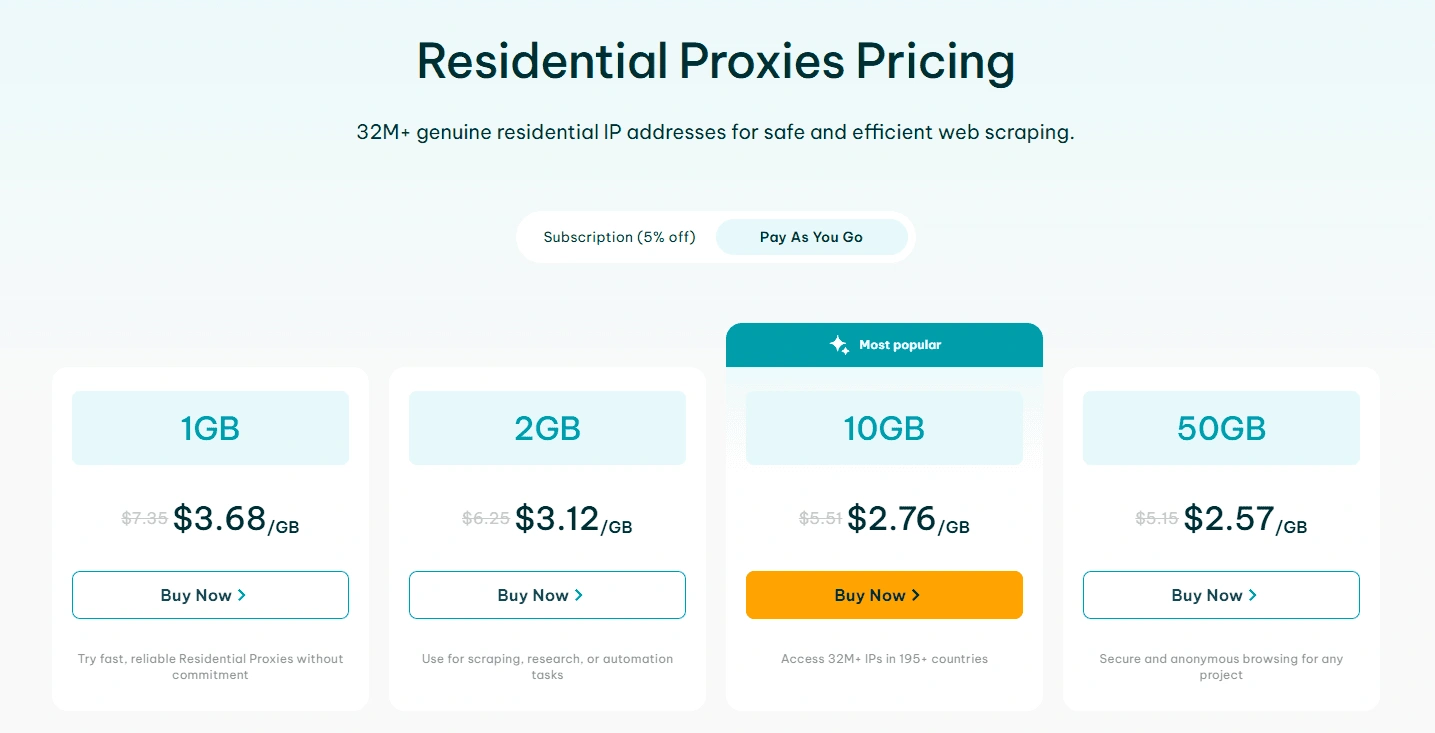
Discount promo codes are also valid for new clients. The service does not provide a free trial. Payment is made using bank cards, cryptocurrencies, and PayPal.
Among additional functionality, it is worth noting Web Unlocker and Video Scraper API, which allow automating the process of collecting information from sites and Youtube.
Dataimpulse
A proxy service specializing in providing unique solutions for business. The company provides server and mobile proxies, as well as standard and premium residential ones. The total pool of IP addresses is over 90 million, covering 190+ countries. Traffic without time limits – you can use the resource as much as you need.
Cost of services:
- Residential proxies – standard residential from $1 per GB, and premium – from $5 per GB;
- Server proxies – from $0.5 per GB;
- Mobile proxies – from $2 per GB
When working with a large volume of traffic, prices decrease by approximately 20%.
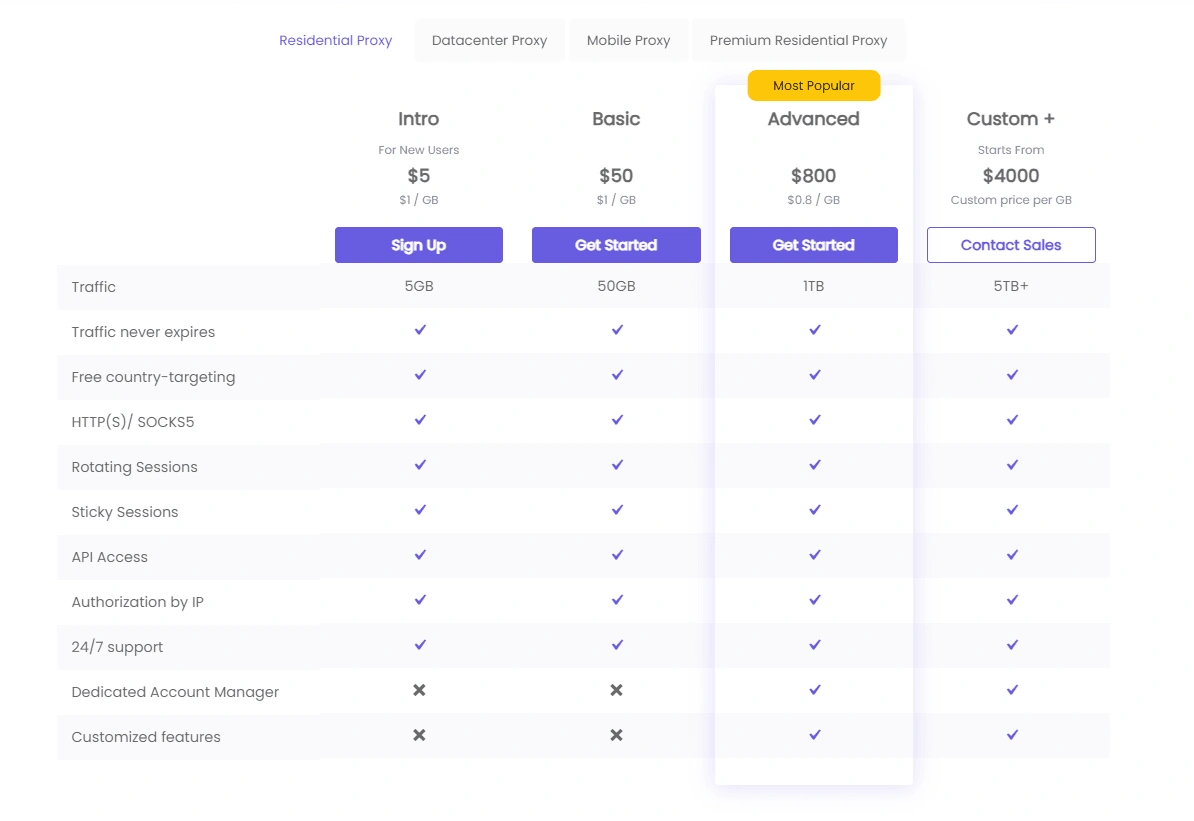
The service does not provide a free trial, but initial tariffs cost $5 – anyone can try. Payment exclusively for traffic. The service accepts payment by bank cards, transfers, cryptocurrencies, as well as settlement using Apple Pay and Google Pay.
Dataimpulse support works 24/7, a competent employee will answer you at any time of the day.
Infatica
Proxy solutions for tasks of various levels. The company offers more than 20 million IP addresses, most of which are residential proxies, where there are both classic and premium IPs. Besides residential proxies, there are static ISP, dedicated and shared data center IPs, as well as mobile proxies.
The service offers a payment model both for actually used traffic and payment for a certain volume. The price changes accordingly.
For example, residential proxies under the Pay As You Go model cost $4/GB, while package formats offer residential proxies for $3.84-3.6/GB with a volume up to 100 GB, and on a large volume of gigabytes it comes out to $2.6-2.7.
The service provides 7-day trial access for a few dollars, the price is $4-8 and depends on the proxy type.
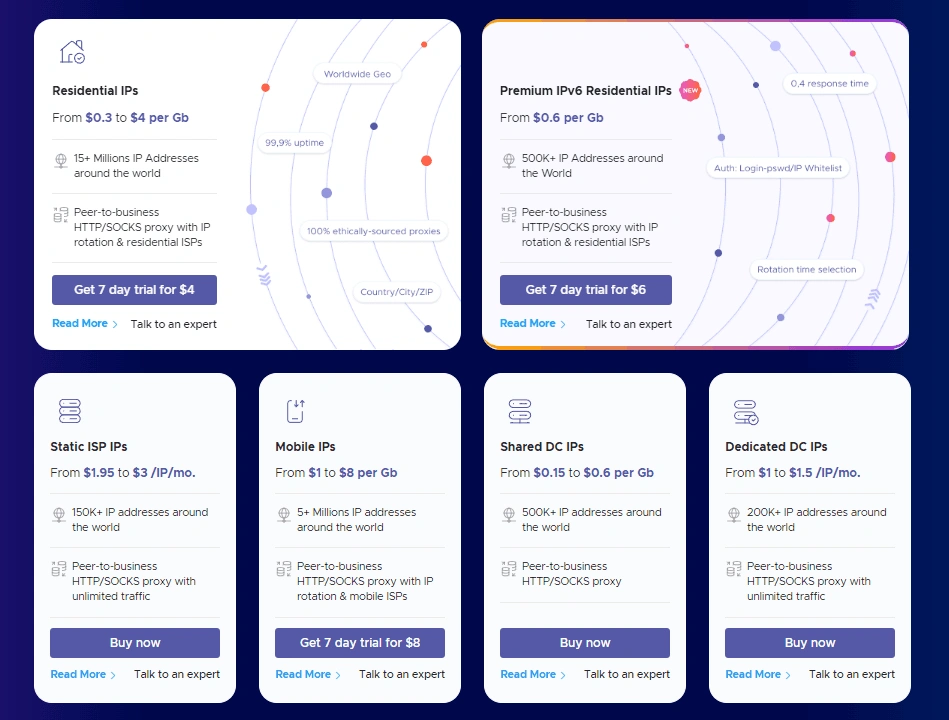
Besides proxies themselves, Infatica also offers a wide range of data scraping services for different platforms.
Payment for services is available using bank cards, PayPal, and other payment systems.
Brightdata
The largest proxy provider for tasks of any complexity. They have a pool with more than 150+ million IP addresses covering 195 countries. Besides the main asset in the form of residential proxies (150 million IPs), they offer clients mobile IP addresses (7 million IPs), ISP (1.3 million IPs), and data center proxies (1.3 million IPs).
They work both by the Pay As You Go format and by standard traffic packages with fixed payment.
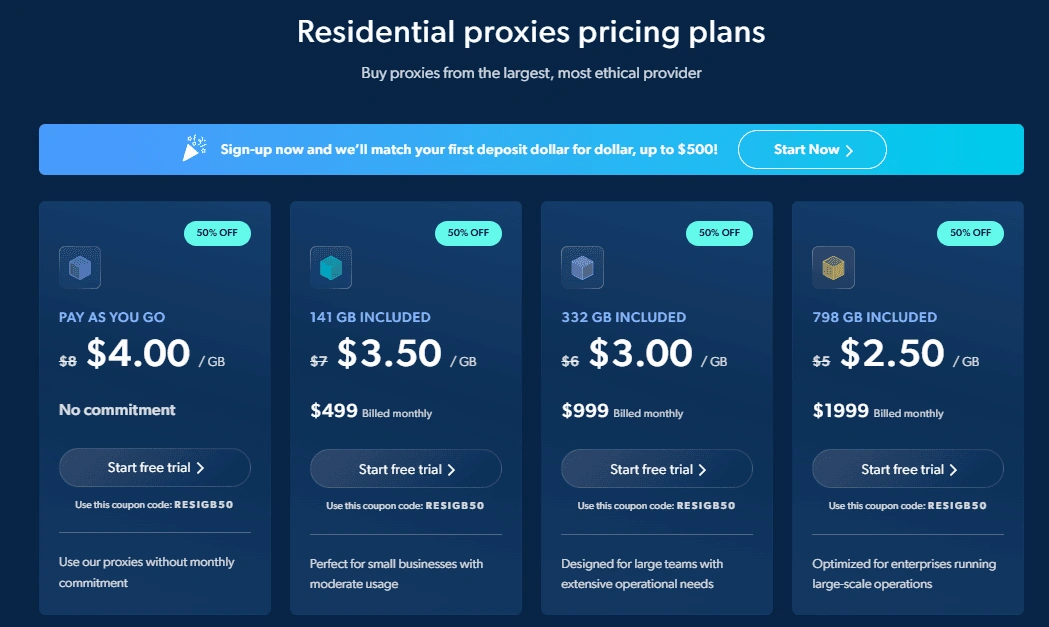
Prices for residential proxies start from $4 per GB.
For new users, there are welcome promo codes, as well as a trial. Payment is supported by bank cards, transfers, Payoneer, and other payment systems.
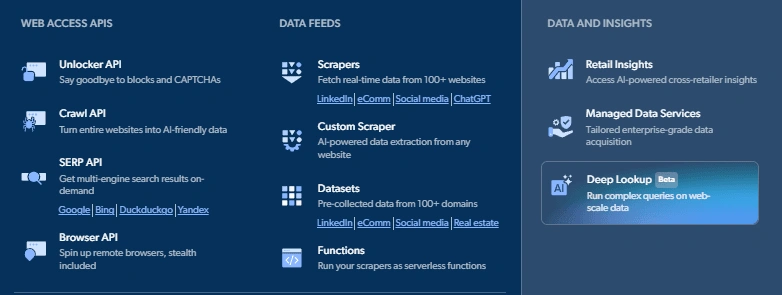
The service is actively developing in the direction of data scraping and develops its own solutions: scrapers, collected data from various sites, parsing functions, etc.
Nodemaven
A proxy service with IP addresses for your privacy. The service has more than 30 million residential and mobile IP addresses. A convenient solution with an emphasis on multi-accounting on any platforms. The service claims its own automatic filtering of IP addresses before issuing to the client, which allows maintaining a high level of proxy quality and a high level of trust in them.
The service works on the Pay As You Go model and with ready-made monthly offers with different fixed traffic volumes.
Under the pay-per-used-traffic model, 1 GB of residential proxies on a volume up to 200 GB will cost from $3.9 to $2.6 per GB – the larger the traffic volume, the cheaper.
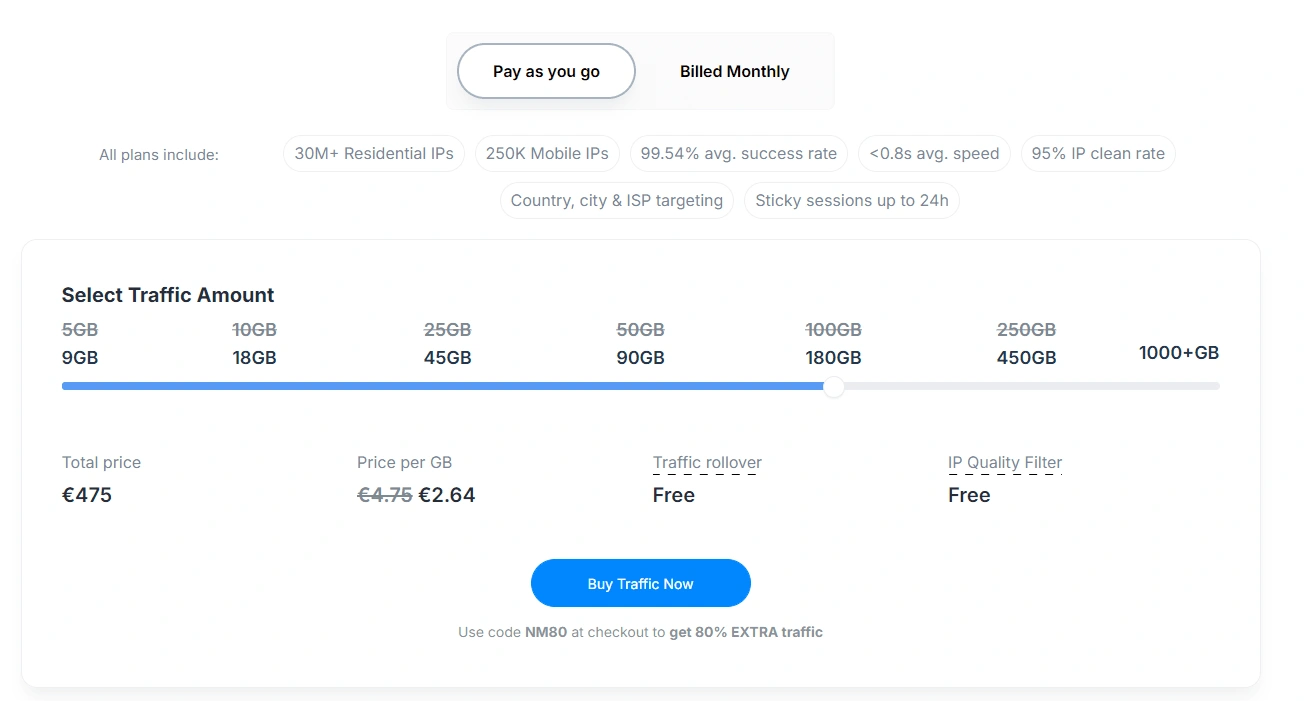
The service offers discount promo codes, as well as a 1 GB trial for $3.99. Payment is available using bank cards, transfers, cryptocurrencies.
Proxy-seller
A proxy service with flexible settings and proxies for any task. Having more than 20 million IP addresses in its asset, the service offers a wide variation of proxies – for social networks, gaming, web scraping, marketplaces, programming, and other tasks.
The company provides residential, mobile, and ISP proxies. There is a choice by protocols – IPv4, IPv6.
Residential proxies with payment for traffic – you buy a tariff plan for a month, and server ones with payment for operation time (without traffic limit).
The price of residential proxies starts from $3.5 for 1 GB, but already at a volume of 100 GB the price will be $2.2 per GB. The more traffic – the lower the price, the lower bar in ready-made tariffs is $1.5 per GB.
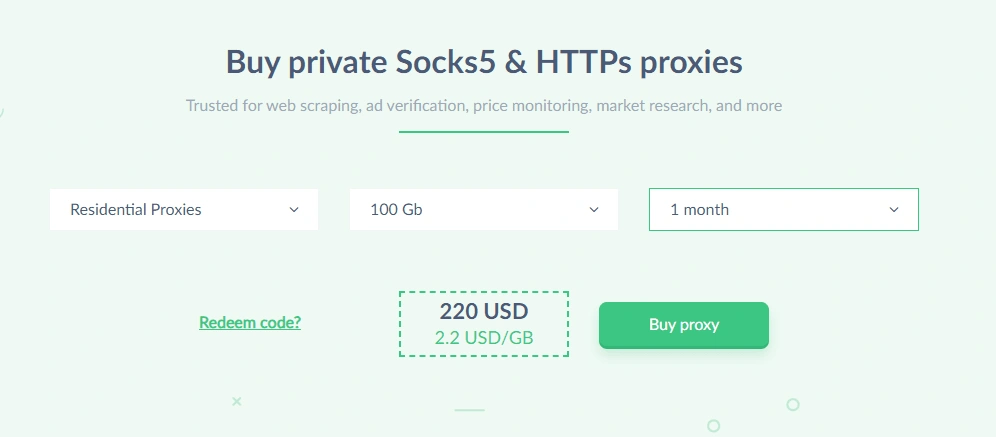
The service is convenient because it has affordable prices and work formats for the average user. Simple and understandable ready-made solutions for a specific task.
There is a 3-day trial for $1.99. For payment, you can use a bank card, PayPal, or cryptocurrencies.
Thordata
Quality proxies with an emphasis on data collection and AI work tasks. Available are more than 60 million IP addresses with high uptime and coverage of 190+ countries. The service provides residential, mobile, and server proxies, as well as infrastructure for working with web scraping – own AI scrapers, ready-made datasets from popular platforms, and various APIs.
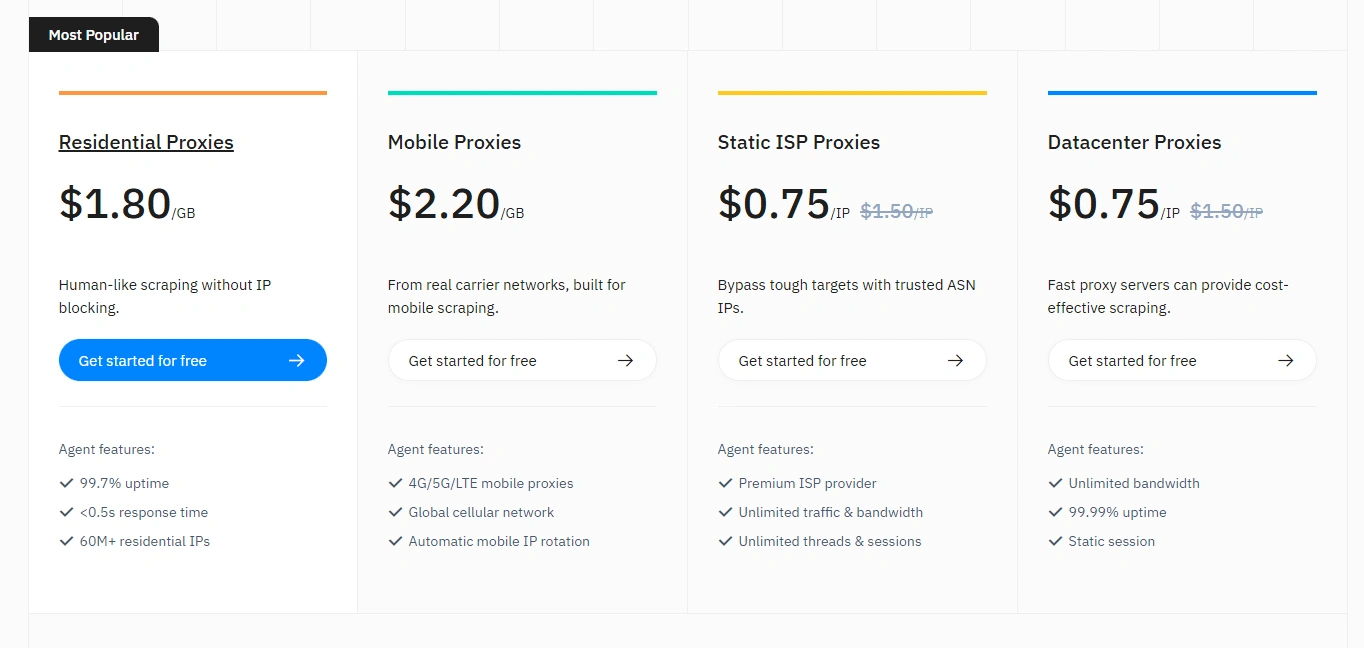
The cost of residential proxies starts from $3.5 per GB and decreases to $1.8-2 on volume. Proxies are sold according to a tariff plan with a fixed traffic volume.
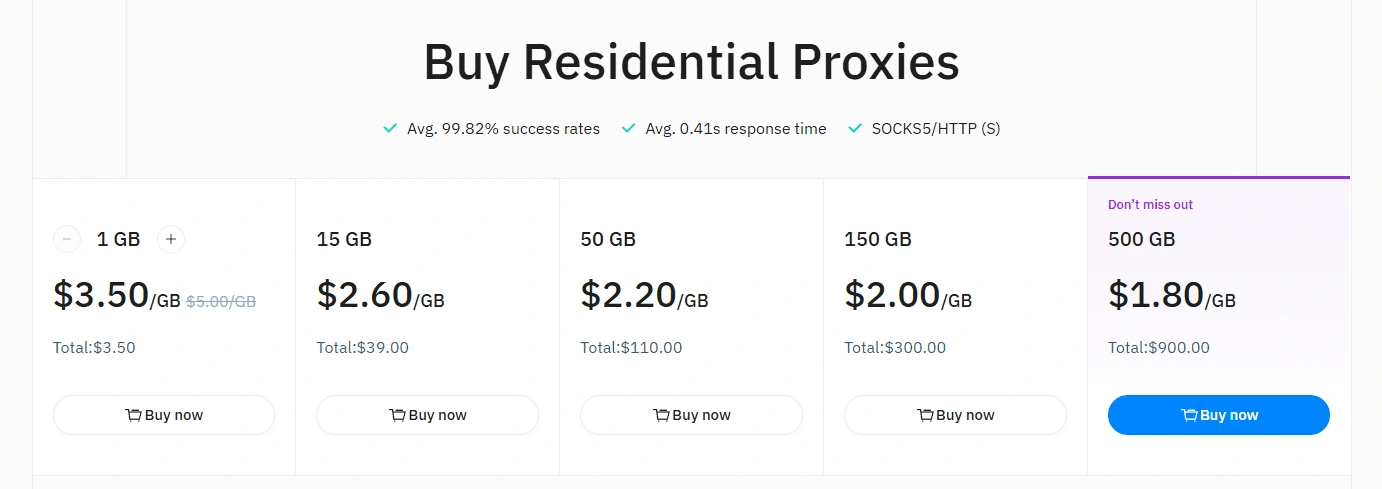
The service provides a trial for new users. Payment is available both using a bank card and PayPal, and cryptocurrencies.
Where to buy the best proxies for work: summing up
Quality proxies are the foundation of effective work with multi-accounting and web scraping. After all, only using a proxy connection can you fully unlock the potential of an antidetect browser. This means you need to choose the best solutions. Not the most expensive, and not the cheapest, but optimal in terms of price and quality ratio – so that workflows are stable, and you do not lose money due to blocking of important profiles.
It is impossible to single out the only best provider – you need to test several, optimizing your expenses with the best conditions without losing quality. In our selection, we highlighted the main market leaders who provide a wide pool of IP addresses with large country coverage, different proxy types, and have a stable reputation in the market – you will definitely get what you buy.
You can always find cheaper local options from small proxy sellers, but this is already a narrowly focused product for a specific task.
Choose quality proxies, test and optimize costs on volume using the "AdsCrusher" functionality in Linken Sphere.