Residential Proxies — Why You Should Choose Them

In this article, we will break down what residential proxies are, where they are best applied, and most importantly, by what criteria to choose a reliable provider so as not to lose money and time.
Why residential proxies are better than other types of proxies
Residential proxies are IP addresses of real users provided by home internet providers. Unlike server proxies, such addresses are tied to specific devices and locations, so the connection looks as natural as possible.
Residential proxies have a number of key advantages:
- Belonging to real users. Due to this, such IPs are not listed in blacklists and anti-bot systems.
- Trust of platforms and anti-fraud systems. IP addresses of real users generally do not arouse suspicion from anti-fraud systems, which allows you to build stable operations on almost any platform and scale processes.
- Rare blocks. Due to the trust and absence from blacklists, residential proxies are blocked significantly less often compared to datacenter ones.
- Choice of IP by various parameters. You can select an address for a specific country, city, provider, or mobile operator. This allows you to cover any narrow tasks, including gaining access to content that is restricted geographically or by provider.
- Rotation support. With residential proxies, you can set up automatic address changes with each new connection or request, which will allow you to simulate the behavior of different users and avoid blocks in case of changing verification criteria.
- Reliability and security. Traffic in residential proxies is encrypted, and sessions practically do not drop, since the connection is built through ordinary online users with a stable connection, which does not arouse suspicion from platforms.
Where you can't do without residential proxies
When we talk about proxies in the context of making money online, there is a whole mass of areas where this tool is indispensable:
- Traffic arbitrage. In the world of affiliate marketing, residential proxies are a basic tool for working with advertising: they allow you to register dozens of advertising accounts (Facebook, Google Ads, TikTok) that do not get banned at the start due to the "cleanliness" of the IP address. Paired with an anti-detect browser, proxies provide the opportunity to drive traffic to different GEOs from multiple accounts and safely test campaign setups without fear of losing the entire advertising infrastructure at once.
- Data scraping. Collecting information from marketplaces, competitor websites, or search engines is impossible without high-quality proxies — otherwise, the scraper will be blocked after the first hundreds or even tens of requests. Residential addresses simulate the behavior of ordinary buyers, allowing you to collect huge arrays of data without captchas and "Confirm you are not a robot" banners. With rotation, you can change the IP for each request, remaining invisible to security systems.
- SEO promotion. To find out the real position of a site in search results, you need to look at it through the eyes of a user from a specific region. And residential proxies exactly allow you to check positions from the desired city or district. Analyzing the link profile and advertising strategies of competitors also requires "live" IPs so as not to fall under search engine restrictions.
- Social media management. Instagram, Facebook, TikTok, and other platforms strictly monitor the binding of accounts to IP addresses: if many profiles log in from one proxy, the anti-fraud system will link them together and send them all to a ban. Residential proxies allow you to manage 2-3 accounts per clean address, safely use bots for mass liking and following, as well as warm up new profiles without arousing suspicion.
- Online games. Many games give regional bonuses or have different prices depending on the country. And residential proxies allow you to log into the Steam client or a browser game as a resident of the desired region and get exclusive offers. In addition, this is the only working way to bypass country blocks on game servers and play with minimal ping, using IP addresses close to the server's location.
How to choose reliable residential proxies
In order to choose the ideal servers for your tasks, it is important to understand how they differ and what choice you have initially. Here are the criteria that must be considered when selecting a proxy provider:
- Type of proxy. There are two main types of this tool: HTTP(S) works only with browsers and websites, while SOCKS5 is universal and supports any protocols (SMTP, FTP, VoIP). For simple web browsing, HTTP/HTTPS is enough, but for maximum anonymity, working with non-browser software, or high data transfer speed, it is better to use SOCKS5.
- Rotation method. Proxies can support rotation — automatic IP change at specified intervals or per request, which is critical in some areas like scraping. But there are also so-called Sticky sessions: this is when the IP address remains unchanged throughout the work with the proxy, which is critical in automated testing, for example.
- Proxy quality. Good servers must provide a continuous and fast connection to the internet. You need to understand that sooner or later all addresses will end up in blacklists and bans, so it is important that the provider regularly updates the database of fresh addresses.
- Price. The cost of residential proxies is formed from several factors: traffic volume, number of issued IPs, and usage period — be prepared that high-quality proxies cannot cost pennies. Compare the tariffs of different providers, but do not chase the lowest price: cheap proxies often turn out to be slow, unstable, or already banned on popular sites. Pay attention to the availability of a trial period or a money-back guarantee — this is a sign of the provider's confidence in their product.
A provider that adequately meets all these points will be able to give you optimal proxies for any work tasks.
5 best residential proxy providers
The proxy server market is overcrowded with various offers for every taste. To make it easier for you to navigate, we have selected five of the most popular and reliable providers.
Asocks
This is one of the largest residential proxy providers on the internet:
- 99.7% successful connections
- 150+ supported GEOs
- over 7 million IP addresses
- over 100 thousand clients.
Asocks provides three types of proxies: residential, mobile, and corporate. You can either choose an unlimited plan or pay only for the traffic used. The minimum price for residential proxies starts at $5 per month, and when paying for traffic, it will be $3 per 1 GB of data.
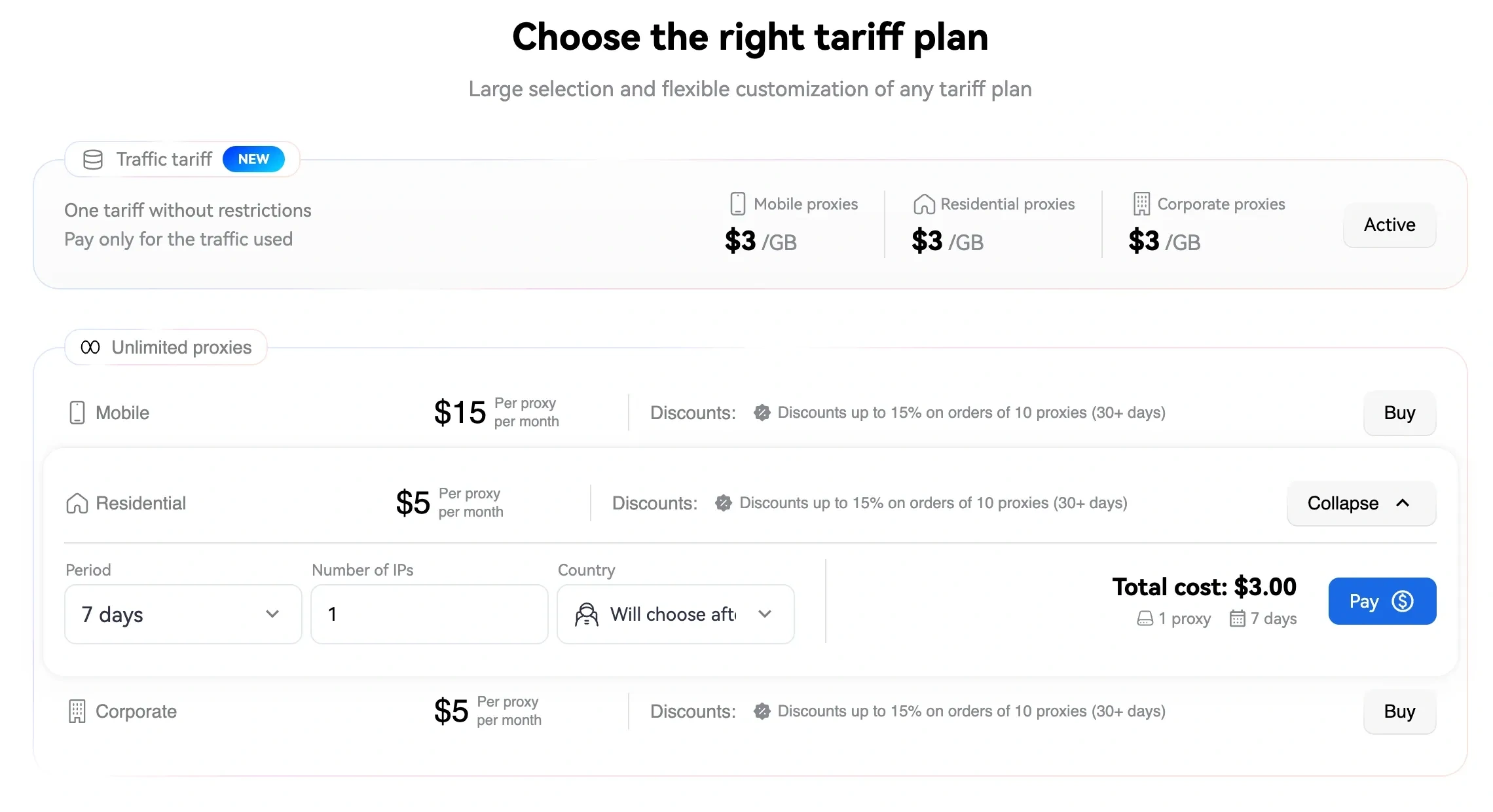
The service is constantly working on expanding new locations and provides 24/7 technical support.
9Proxy
The platform specializes in providing high-quality residential proxies with HTTP, HTTPS, and SOCKS5 protocols. In total, it has over 9 million IP addresses in 90+ countries, and you can choose down to the provider and zip code.
When it comes to the cost of services, 9Proxy has two main plans:
- Pay by quantity: from $20 for 100 IP addresses, and the larger the order, the more profitable the price per address.
- Pay for traffic: from $3 per 1 GB, and when buying 2000 GB, the price drops to $0.75/GB.
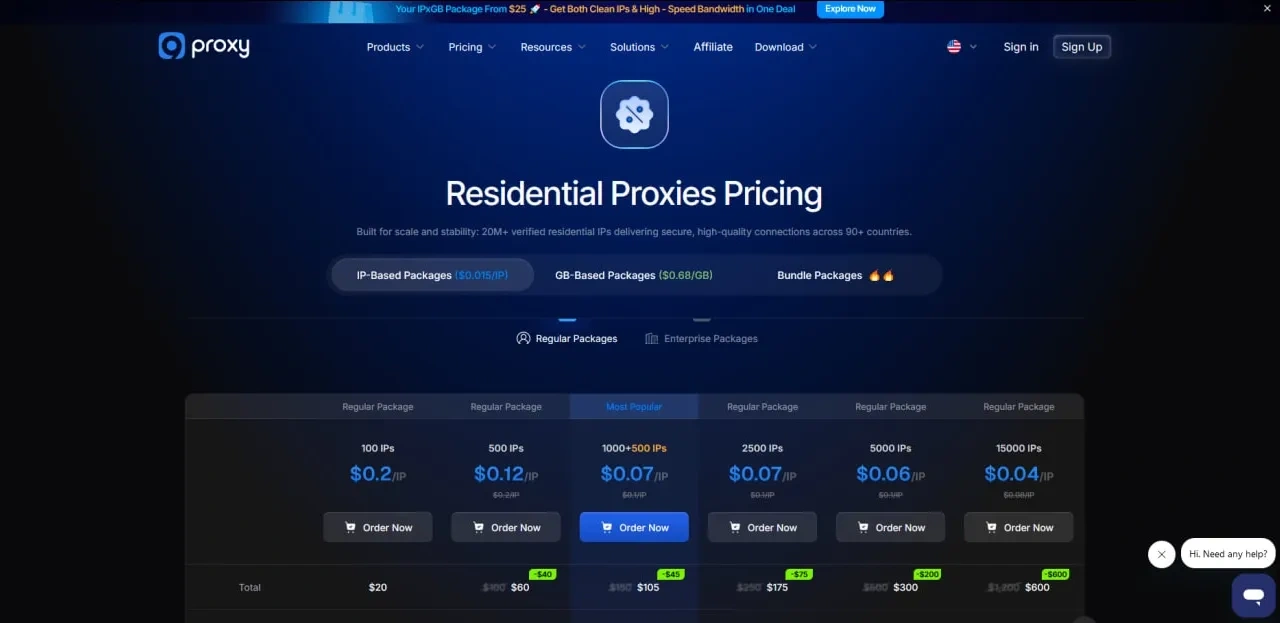
9Proxy also has an affiliate program where affiliates can earn up to 15% of the expenses of attracted referrals. What is especially nice, this money, in addition to expenses for internal services, can be withdrawn to a crypto wallet.
Proxys.io
A service whose main focus is on convenience and simplicity of the interface. The selected proxies are activated immediately after payment, which is done in a couple of clicks, and support is available around the clock. The client can choose from 195 countries and more than 100 million IP addresses.
Prices for residential proxies in Proxys start from $4 per 1 GB. Server and mobile proxies are also available for purchase.
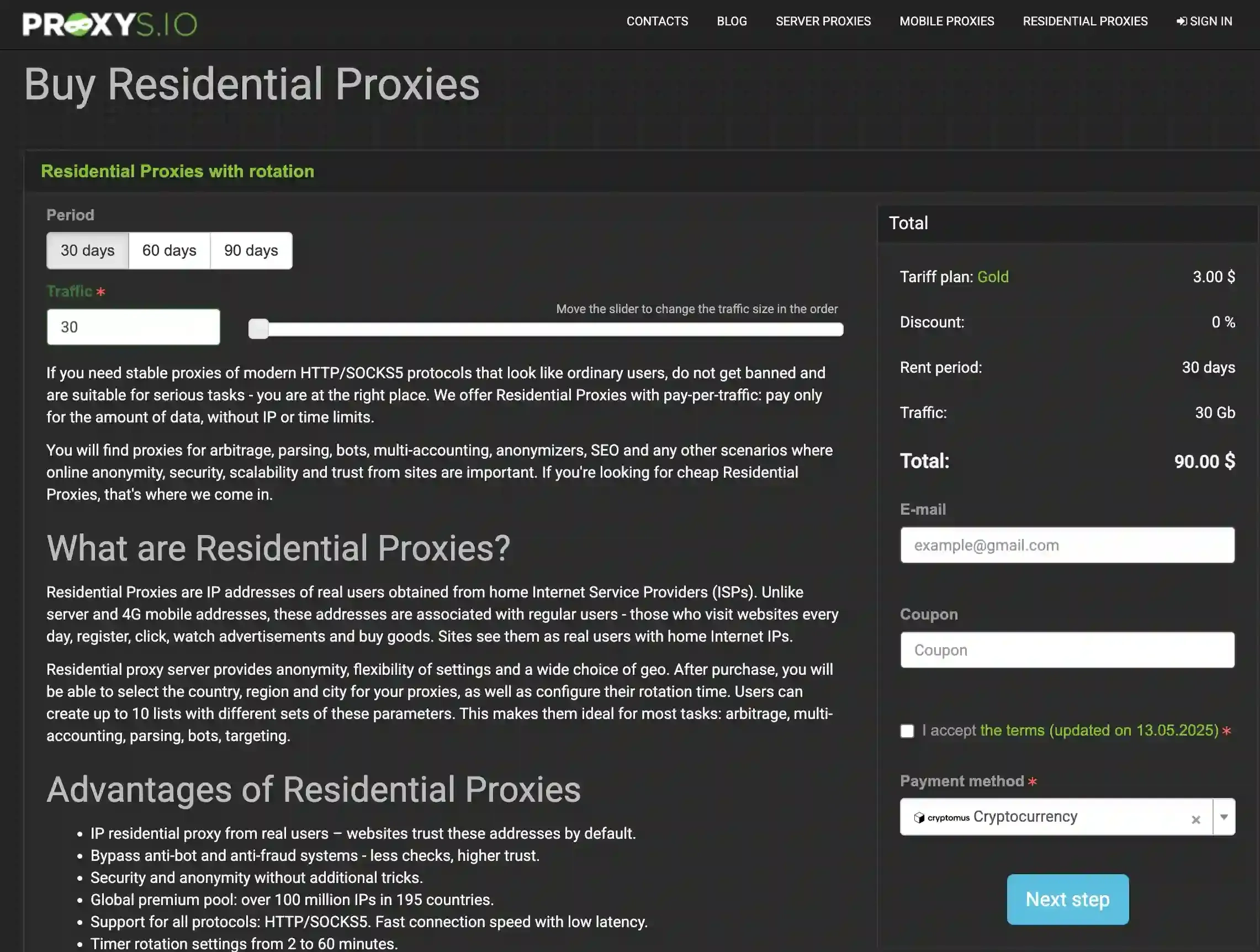
More than 50 payment methods are available in Proxys, including fiat methods and cryptocurrency transfers. The service also has a perpetual affiliate program with a rate of 20% of all expenses of your referrals.
MangoProxy
On this site, you can purchase residential, mobile, and server proxies for 200+ countries. Over 90 million IP addresses are available, and a pleasant plus is the availability of the service in Russian.
Prices in MangoProxy are average for the market: $3.3/GB. The larger the volume of traffic you take, the cheaper 1 GB will cost, and when using over 3 TB, the final cost is discussed individually.
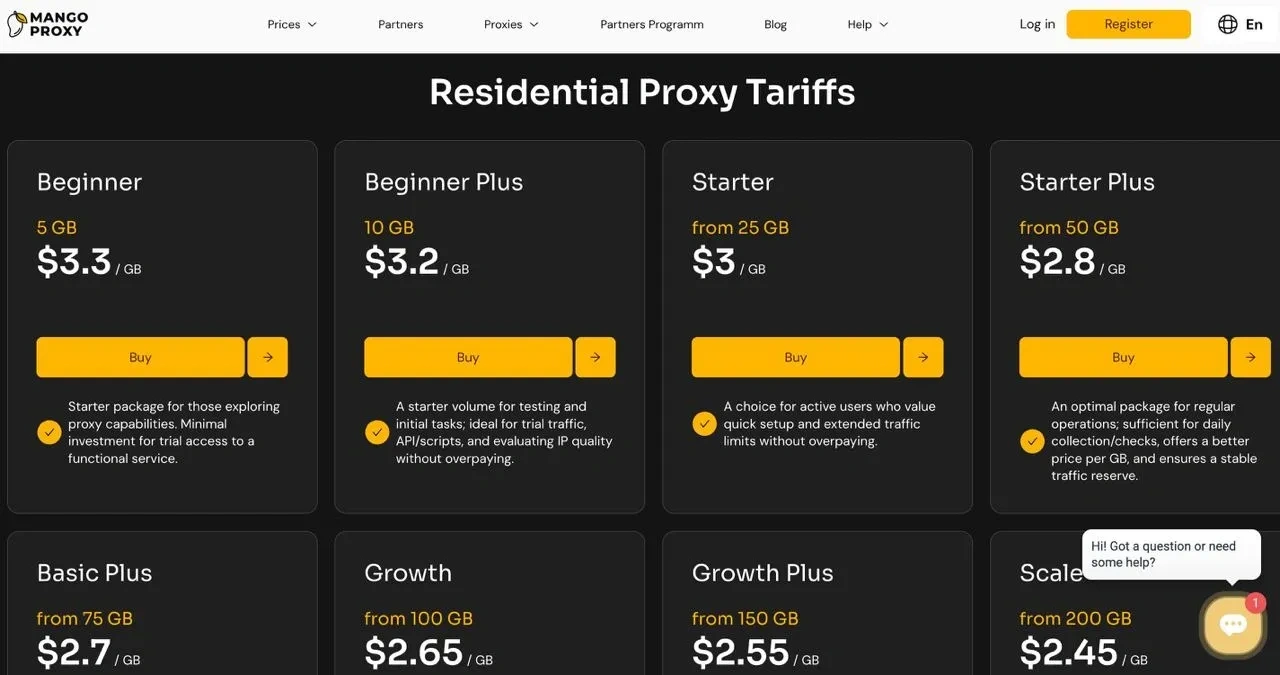
New IPs appear in MangoProxy every day. The service supports integration with more than 450 tools, including anti-detect browsers, scrapers, and trackers.
Proxyma
A popular service with an arsenal of more than 60 million unique addresses and 190+ GEOs. Proxyma offers all popular types of proxies, and even divides residential ones into 3 types depending on the tasks: for crypto projects, e-Commerce, and scraping.
The starting price of a gigabyte in Proxyma is $5. It is more profitable to take a package for $30: it will give 10 GB of traffic and 1000 ports.
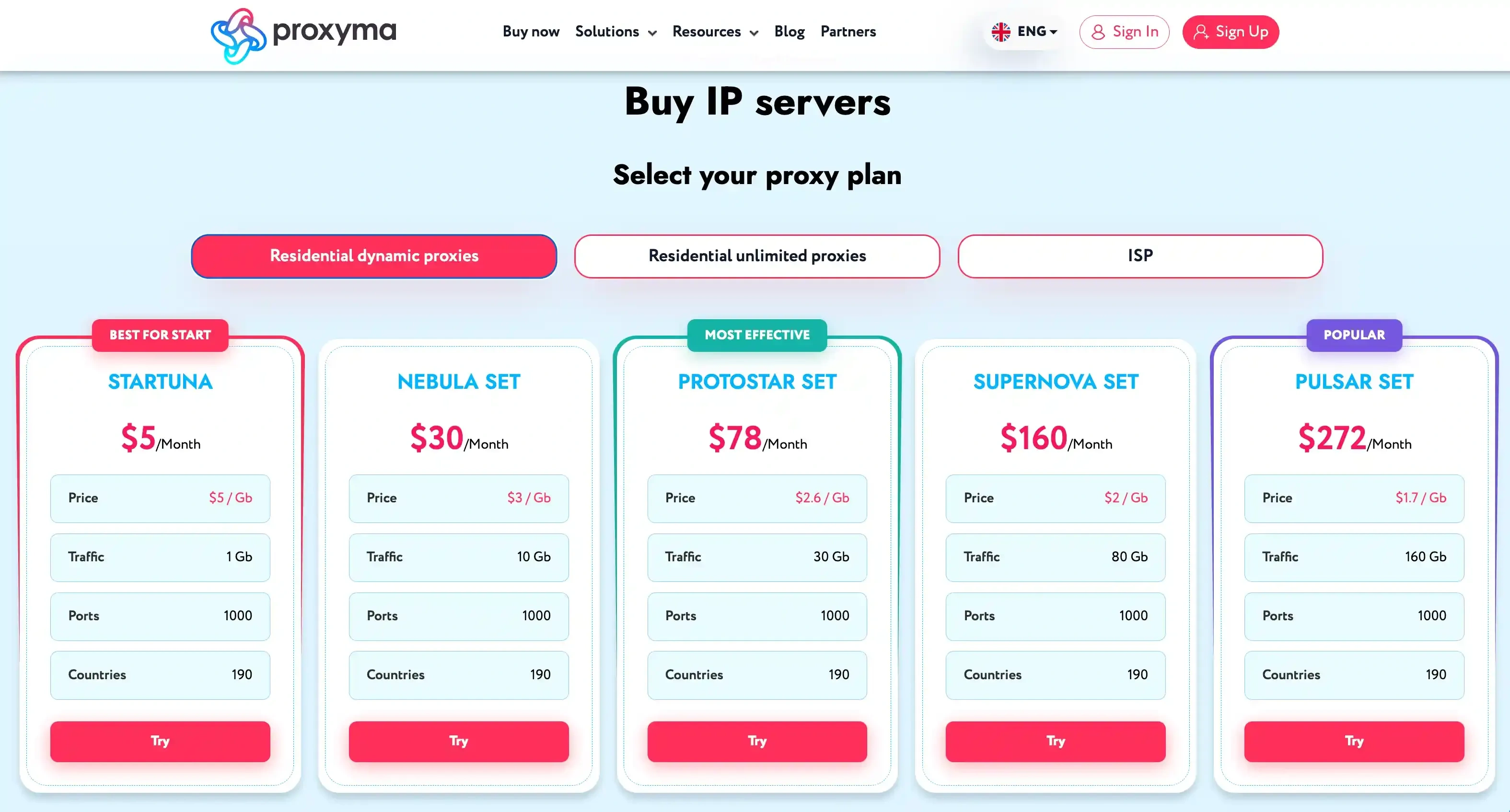
Proxyma's technical support is in touch around the clock: on average, non-working addresses, the share of which does not exceed 1% of the total mass, are replaced in less than 30 minutes. Cryptocurrencies, bank cards, PayPal, and other payment systems are available as payment methods.
How to spot low-quality residential proxies
Even the best proxy providers can issue weak and unsuitable products for work. This can be easily understood by the following signs:
- Low connection speed. Residential proxies are generally slower than server ones, but the speed should be enough to perform basic tasks.
- Frequent connection drops. Constant disconnects make work impossible, especially if you manage social networks or work with advertising accounts. Without a stable uptime of 99.9%, there is no point in overpaying for residential proxies.
- IP address blocking. The easiest way to check a proxy is to try to access popular sites in the region through it. If the site greets you with a captcha, a message about suspicious activity, or blocks access, then this IP has already been flagged and blacklisted.
- IP address spoofing. It happens that a provider promises residential proxies, but in fact slips cheaper server ones — they are easy to figure out through a whois check or specialized databases like ip2location.
- Mismatch with the declared GEO. Another typical problem is that you buy servers of one country, and during the check, you see that they belong to a completely different GEO. Always check the real location of the IP through geolocation services (check-host.net or whatismyipaddress) and compare it with the declared one: reputable providers provide real IPs of the selected countries, not formal GEO tags.
Conclusion
Residential proxies are IP addresses from real home connections, characterized by high trust from internet platforms, reliability, and security. They are used when the connection must be stable and look as natural as possible to anti-fraud systems, when testing GEO versions of resources and applications, and parsing data. Carefully study and check the proxy provider before starting cooperation with them, or refer to the list of verified sellers from this article.
Frequently Asked Questions
The easiest way is to use special checker services (whoer.net or check-host.net) that will show your IP and location: if the data matches the parameters of the issued proxy, it means the connection is working.
There is no definitive answer — it all depends on the requirements of a specific site and the quality of the proxy itself, but for most popular services, it is recommended to use no more than 2-3 accounts per IP address. Major platforms (Instagram, Google, Facebook) closely monitor activity and can block all accounts if their data matches. The optimal strategy is to use a separate proxy for each account.
The main alternative is mobile proxies, which use the IP addresses of cellular operators. They provide a high level of trust but are more expensive than residential ones.
Unlike virtual servers, residential proxies use real IP addresses of regular users issued by ISPs — such IPs are harder to obtain, but anti-fraud systems treat them with greater trust, which reduces the risk of bans. In addition, the cost is affected by the limited number of addresses and billing per gigabyte of traffic.