Bonus Hunting 2026 — What to Hunt For

Classic bonus hunting no longer works in 2026. Previously, the scheme was as simple as possible: register an account for a relative or friend, claim a no-deposit free bet, place an arbitrage bet (surebet) using a bonus calculator, and withdraw the profit.
Now, bookmakers and online casinos are tired of losing money to bonus hunters and have strengthened their defenses: both legal and offshore platforms actively use neural networks to ensure security. They constantly analyze huge volumes of data and quickly identify the typical behavior of bonus hunters.
Today, bonus hunting requires a serious budget. Money goes towards anti-detect browsers, residential and mobile proxies, as well as paying for the services of drops. Any mistake can end in a block. A dirty IP, a timezone mismatch, or suspicious activity — and the account quickly gets banned along with the money. So, is it still possible to make money?
Current bonus hunting schemes: what they are hunting for now
Let's break down the main methods that work today.
Betting
In sports betting, bonus offers are traditionally divided into welcome bonuses (for new players) and loyalty programs (for retaining old ones). The strategies for working with them differ radically.
Free bets + surebets (sports arbitrage). This is an old scheme that has changed slightly over time. A player receives a free bet at one bookmaker and bets it on an event. In parallel, a bet is placed on the opposite outcome at another bookmaker — this time using their own money. This makes it possible to lock in a small profit regardless of the match result.

But in 2026, anti-fraud systems easily find "clean" surebets — situations where the odds provide guaranteed earnings. If a new account starts betting on such events, it is quickly detected and doesn't live long. Therefore, they act more carefully now. Free bets are used on events chosen by regular players — popular matches, famous teams, and simple bets like a win or total.
Betting on little-known leagues or strange statistics immediately looks suspicious and attracts the attention of anti-fraud systems. The main task of a bonus hunter is to make the account's behavior look natural.
Cashback abuse (VIP programs and rakeback). One of the most profitable and yet complex schemes is bankroll transfer for the sake of cashback. Here, the goal is not to lose money, but to carefully transfer it from one bookmaker to another and earn on loss bonuses.
Many bookmakers credit active players with cashback — for example, 10–15% of the lost amount. The scheme is built on this. Two bookmakers are needed. The first is the donor. This is a bookmaker with a loyalty program and cashback for losses. The second is needed only to cover the bets. Usually, bookmakers with low margins and high limits are chosen.

Next, opposite bets are placed on the same event in different bookmakers. Near-zero surebets are used — situations where the difference between the odds is minimal, usually around 0–0.2%. Such bets look almost like regular play and rarely arouse suspicion. Arbitrage situations can be found in scanners, for example in SureBet.
As with welcome free bets, you should only choose top events — popular matches and famous teams. Bets on little-known leagues or strange markets quickly attract the attention of anti-fraud systems.
To the bookmaker, this looks like the play of a person who is constantly losing. At the end of the billing period, the bookmaker credits cashback based on the lost amount.
Live bonuses and accumulator boosts. Bookmakers often offer promotions like "Build an accumulator of 5 events and get a +20% bonus to the final odds." From the outside, it looks like a lottery, but experienced bonus hunters extract guaranteed profit from this using a sequential hedging strategy.

The mechanics work like this:
- Assembly. An accumulator is built in the bookmaker with the promotion. The main condition is that the matches must not overlap in time (for example, they play strictly one after another: on Monday, Tuesday, and Wednesday).
- First step. A single bet is placed in another bookmaker on the opposite outcome of only the first event.
- Fork. If the first match in the accumulator loses, the accumulator burns, but the hedge bet wins and locks in the profit. The chain is complete.
- Continuation and bet growth. If the first match wins, we lose money on the hedge. The accumulator lives on, and we move to the second match. The key point: the bet amount for each subsequent hedge is calculated in a special calculator (Sequential Lay Calculator) and constantly increases. It must recoup both the initial bet on the accumulator and all the money lost in the previous steps.
- Result. Thanks to the bonus boost (that very +20% to the total odds), the math always works out. It is this bonus that covers the bookmaker's margin and the growing hedging amounts, putting the player in the black at whatever stage the accumulator is interrupted.
An additional profit of the scheme: for the anti-fraud system, a user who places live accumulators is an ideal, gambling amateur client. This style of play warms up the account well. Accumulators are a common story for most players, so the profile looks natural. Because of this, limits are usually cut less often, and security checks do not happen as frequently.
P2P betting and Web3. Classic bookmakers now have strict rules: the slightest suspicion — and they ask you for a selfie with your passport, utility bills, or check your knowledge via video call. For bonus hunters, this is a huge risk, because an account with money can be frozen at any second.
Therefore, many are now massively moving to crypto — to Web3 platforms (for example, Dexsport) and decentralized P2P betting exchanges (SX Bet, BetDEX, Polymarket).

In Web3 betting, there are practically no classic "first deposit bonuses." There is a completely different economy there, and bonus hunters hunt for three things:
- Retroactive airdrops and point farming. Platforms like BetDEX or Polymarket reward early users. You are awarded points for every bet. Bonus hunters use a "wash-trading" strategy: they connect two different crypto wallets and place opposing bets on the same match. They lose pennies on network fees but generate a colossal turnover, for which the exchange later awards them its tokens worth thousands of dollars. These tokens are immediately sold on a crypto exchange.
- Trading volume tournaments (Leaderboards). Exchanges like SX Bet regularly raffle pools of tens of thousands of stablecoins (USDC) among those who make the highest betting turnover in a week. The scheme is the same: transferring the balance with near-zero surebets between your own wallets for the sake of a guaranteed prize place.
- Free bets for smart contracts. Some platforms credit clean free bets in USDT simply for connecting a wallet (for example, MetaMask) and completing simple tasks on social networks.
Why bonus hunters choose exactly these platforms:
- Complete anonymity. No document checks, selfies, or nervous video calls with security. To them, you are just a crypto wallet address.
- Ironclad payouts. Money on such platforms is managed by independent software code. Fulfill the conditions — the winnings automatically drop into your wallet. No one has the power to cancel the transaction.
Due to weak control and new bonus mechanics, the Web3 sphere in 2026 has become one of the most convenient options for those who systematically earn on bonuses.
Where to look for betting bonuses. To find current and fresh offers, aggregators and specialized sites are used, for example, Legalbet or SportClan. When a generous bonus with positive math appears on the market, bonus hunters immediately launch their account farms into operation. The task is simple: manage to take the maximum from the promotion before the bookmaker notices the influx of players and tightens the wagering requirements.

Gambling
The online casino industry is also not standing still and is actively tightening the screws. The era when you could make a deposit, quickly wager a bonus, and leave with the money is irretrievably gone. We can highlight four main trends in casino abuse in 2026:
Multi-level bonuses. Instead of giving out one large bonus for the first registration, casinos often divide the rewards over the first 3–5 deposits. For example, Ice Casino promises up to €1500, but issues it in parts. Their goal is to force you to keep your money in the system for as long as possible. A bonus hunter has to make several deposits in a row, carefully calculating at which stage of wagering the math might go negative.

Risk-Free Spins. This mechanic is now often found in licensed casinos. The promotion usually looks like this: "Make 50 spins at $1. If you are in the red at the end — we will refund the loss in cash." At first glance, it seems impossible to make money here. But everything is built on the volatility of the slots.

The bonus hunter chooses a slot with high volatility — such games rarely bring a win, but sometimes yield large multipliers like x100 or x500.
Next, two scenarios are possible:
- The slot gives nothing — the deposit is lost. The casino refunds this amount according to the terms of the promotion, so the player breaks even.
- The slot gives a bonus game or a large multiplier. The balance increases sharply, and this difference can be withdrawn as profit.
The profit comes from scale. The promotion is run simultaneously on a large number of accounts. On most slots, the money will simply be returned by insurance, but on a few accounts, large wins will drop. It is these that bring the final profit.
The secret is that professionals do not even try to clear this harsh wager "head-on." They look for a specific type of offer — the so-called "parachute" (non-sticky) bonuses.
Double wager and salvation through "Parachute bonuses" (Non-sticky). The toughest casino defense is the double wager. While previously you only had to roll over the gift money in slots, now the "Bonus + Deposit" rule has become the standard: you have to wager both the bonus and your own deposit. For example, you deposited $100, received $100 on top, and need to roll over $7000 (x35 wager). Trying to clear this with regular bets is mathematical suicide; the casino will take everything.
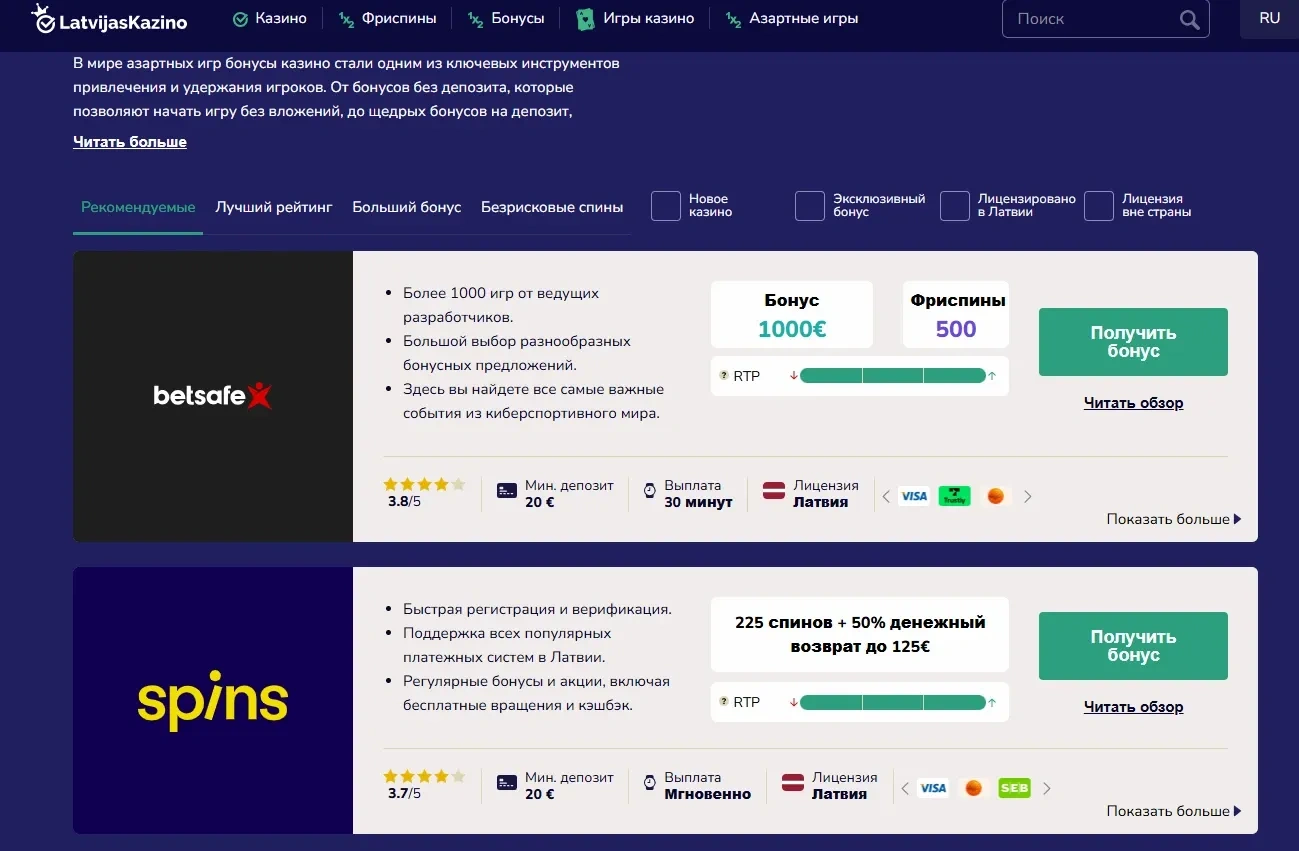
Therefore, bonus hunters monitor aggregators: for example, on the resource Latvijaskazino exclusively in search of "non-sticky" bonuses. This is a mechanic where your real deposit and bonus money lie in different accounts, and you start playing with your own hard-earned cash.
The abuse algorithm looks like this:
- Aggressive start. The user enters a slot with maximum volatility and places large bets with their real money. Their goal is to catch a huge multiplier in the first minutes of the game.
- Canceling the bonus (Plan A). If the slot yields a large win before the real money runs out, the bonus hunter goes to their personal cabinet and simply clicks the "Cancel bonus" button. The gift money burns, but along with it disappears the entire gigantic wager. The player instantly withdraws the net profit.
- "Second chance" (Plan B). If the real money burns, the bonus account opens (the parachute deploys). Only at this moment does the wager turn on. Now there is nothing to lose — it's someone else's money. The player buys bonus games or hits with maximum bets. The task: either quickly drain this balance to zero and move on to the next drop account, or hit a jackpot large enough to cover any wagering requirements.
It is the use of parachute bonuses that turns the hopeless math of a double wager into a profitable strategy.
VIP cashback abuse. The scheme works through live casinos. Tables with live dealers (for example, from Evolution) are used simultaneously in many online casinos. The exact same table can be opened simultaneously on different platforms.

First, two casinos are chosen. The first is the donor. It has a high cashback for losses, for example, 15–20%. The second is the hedge, that is, a regular casino without cashback, which is needed only to cover the bets.
Next, they open the same table, for example, roulette or baccarat, but through different casinos. After that, they place opposite bets. For example, in the donor, they bet on the Player, and in the hedge casino — on the Banker.
As a result, one bet wins, the other loses. The money simply transfers from one account to another.
Crypto
Cryptocurrency platforms pour millions of dollars into marketing to capture market share. But they don't just give away money for nothing — usually, beginners are showered with "futures bonuses" or "trading vouchers" that cannot be withdrawn.
To turn these wrappers into real cash, bonus hunters use three main mechanics:
- Futures bonus abuse (position hedging). Let's say an exchange credits a $100 bonus to a futures account. The bonus hunter takes two drop accounts (or two different exchanges). On one account, they open a Long position (on the asset's growth, for example, BTC) with maximum x100 leverage. On the second account, they open a symmetrical Short (on the fall). At the slightest market movement, one account catches liquidation — the bonus $100 burns there, which couldn't be withdrawn anyway. But on the second account, the position brings $100 of net profit.
- Wash Trading (volume inflation). Exchanges often organize tournaments or distribute pools of tens of thousands of dollars to those who make the maximum trading turnover. Bonus hunters use automated scripts and trade stablecoin pairs (for example, USDC/USDT, where the rate is always 1 to 1). They simply toss money back and forth, losing mere pennies on trading fees, but artificially inflate the turnover to millions of dollars, taking the main prize places.
- Sybil farms (Sybil Attacks). Under promotions like Learn-to-Earn or Mystery Box giveaways for registration, bonus hunters drive in entire networks of accounts. Through anti-detect browsers, 500–1000 profiles are registered. Even if the promotion brings only $10-15 per account, scaling turns these pennies into $10,000+ of net profit in a couple of days of work.
Where to look for crypto bonuses? Manually monitoring dozens of exchanges is pointless — promotions appear and disappear every day. Usually, ready-made selections and specialized resources are used, where current offers with a description of verification conditions are already collected. For example, fresh top lists of platforms giving away welcome bonuses right now are regularly published and updated on resources like VC.ru.
Bonus hunter's infrastructure: how to bypass anti-fraud
In 2026, working from a single home computer and a regular browser is practically impossible — the account will be quickly blocked. Security systems check the device, and look not only at the IP, but also at the computer's digital fingerprint: hardware characteristics, video card, MAC addresses, installed fonts, Canvas and WebGL operation, cookies, system language, and many other parameters.
For stable work and income scaling, a well-thought-out infrastructure is needed.
Anti-detect browser
One of the main tools is an anti-detect browser. Programs like Linken Sphere allow creating hundreds of separate browser profiles on a single computer.

Each profile works in isolation and receives its own digital fingerprint. The browser spoofs system parameters: data about the operating system, video card, processor, screen resolution, and other device characteristics.
As a result, for a bookmaker or other platform, each such profile looks like a separate person logging in from their own computer.
Proxies
Spoofing just the browser fingerprint is not enough — you also need to hide your real IP address. In 2026, server proxies will bring an instant ban, since their IP addresses have long been on the blacklists of all bookmakers and casinos.
Suitable for work are:
- residential proxies — IP addresses of real home providers
- mobile proxies — IP addresses of mobile operators can be used simultaneously by thousands of people, so bookmakers rarely block them, otherwise many regular users would fall under the ban.
Account verification
The main barrier to scaling is the verification procedure (KYC). Each account must be linked to a real person, and platforms are increasingly strictly checking the authenticity of data.
Upon the first withdrawal of funds, and sometimes earlier, the platform may request a full check. One of the simplest options is a selfie with a passport and a piece of paper showing the current date and the name of the bookmaker. Additional documents are often required to confirm the address: a utility bill or a bank statement.
Video verification is also increasingly being used. The application may ask you to turn on the camera, turn your head, blink, or smile to ensure that there is a live person in front of the camera, not a photograph.
Some platforms conduct verification in the format of a video call with a security employee. During the conversation, simple questions are asked — for example, about the bets placed, selected events, or basic sports rules.
In practice, bonus hunters scale through acquaintances, friends, and relatives who voluntarily register accounts in their name and, if necessary, are ready to go through verification themselves. Each such participant must understand the conditions and be in touch.
Clean payment systems
Depositing money into a bookmaker is not the most difficult task. It is much more important to withdraw it without problems later. Now, security systems carefully check payment data. If the card or wallet does not match the account owner's data, this quickly arouses suspicion.
All payment methods (bank cards, e-wallets like Piastrix, TSUPIS accounts, or crypto wallets) must be registered to the same person to whom the account is registered.
An attempt to withdraw money to another person's card, even with a similar surname, almost always ends in a block. The bookmaker may freeze the account and transaction pending verification, and the bank may stop the operation according to financial control rules.
Conclusion
Bonus hunting in 2026 has finally transformed from an easy side hustle into hardcore financial arbitrage. The confrontation with bookmakers and casinos has moved to the level of algorithms: neural networks and anti-fraud systems of the platforms fight against automated software, hedging calculators, and account farms.
The era of searching for primitive "holes" in the rules is over. Today, earnings are built on flawless math and the exploitation of complex mechanics — from the abuse of parachute bonuses in gambling and step-by-step hedging of live accumulators to wash trading on decentralized Web3 platforms. This is a full-fledged business with a high entry barrier, where everything is decided by the volume of working capital, the quality of consumables, and financial discipline.
Frequently Asked Questions
Legally, yes. However, according to the bookmakers' own rules, multi-accounting, arbitrage betting, and bonus abuse are prohibited. If detected, the account can be blocked and winnings voided.
For normal operation, you need between $1,500 and $2,000. This money goes toward an antidetect browser, proxies, account registration, and hedging bets.
A free bet is a one-time promotion: you get the bonus, hedge the bet, and withdraw the profit. VIP cashback is a long-term scheme: money is funneled between accounts, and the profit comes from getting a percentage of the losses back.
The account owner must complete the verification personally. They usually ask about recent bets, deposits, and basic sports knowledge. It is important for the person to remember their account history on the platform and answer confidently.