Traffic Arbitrage — What It Is, How It Works, and How to Start for a Beginner
Traffic arbitrage might look like a simple money-making scheme from the outside, but in practice, it is a process of several sequential stages where logic and number control are important. To understand where the profit comes from and exactly where money is lost, it is important to analyze the mechanism itself.
In this article, we will look at how the traffic arbitrage scheme is structured, what stages it consists of, and how a beginner can start earning.
How Traffic Arbitrage Works: Explaining the Scheme in Simple Words
Traffic arbitrage is an online earning model where a person attracts users to a specific offer and receives payment for their actions. For example, a bank's affiliate program pays 2,000 rubles for a referred client who takes out a loan. Income is generated when the value of these actions is higher than the cost of attracting traffic.
It is important to understand: traffic in arbitrage can be paid and conditionally free (organic). The principle of earning is the same in both cases — the difference is only in the method of attracting people.
What the Process Looks Like
1. Traffic Attraction
The affiliate marketer (arbitrageur) finds users:
- through paid advertising (social networks, ad networks, search advertising)
- through organic traffic — content in social networks, videos, posts, accounts, organic reach.

Example of video advertising on Facebook
2. User Transition
A person sees the ad or content, gets interested, and clicks through to the offer page — a landing page, website, app, or registration form.
3. Target Action
The user performs the required action: buys a product, leaves a request, registers, installs an app, etc.

Example of an interactive application form
4. Payout
The advertiser or affiliate program pays the marketer a reward for the confirmed action.
If the income from the actions obtained exceeds the costs of attracting users (money, time, resources), the marketer makes a profit.
Traffic Arbitrage for Beginners: First Steps
If you are just starting to figure out traffic arbitrage, it is important to act sequentially. This sphere is built on tests, analytics, and proper preparation. Below is the basic order of actions for starting.
Step 1. Choose a Traffic Source
At this stage, it is important to determine exactly where you will attract users from. In arbitrage, traffic can come from social networks, search advertising, various ad and teaser networks, as well as from organic sources — through organic content reach. Each source differs in audience, moderation rules, cost, and speed of obtaining results.
The choice of source must correspond to the offer and the behavior of the target audience. For example, complex financial products are perceived worse in entertainment formats, while impulse offers, on the contrary, work better in dynamic formats and content platforms. The more accurately the offer, audience, and traffic source match, the higher the probability of getting conversions and making a profit. You need to understand that most offers worked with in traffic arbitrage are on the verge of what is allowed. Your task is to find an opportunity to advertise products so that the ad passes moderation.
In any case, bans are part of the job; you need to understand this and prepare replacement accounts in advance. For working with multiple accounts, we recommend using Linken Sphere — an anti-detect browser that allows you to scale without restrictions on any platform.
Step 2. Choose a Vertical and Offer
An offer is the product or service you will be promoting. A vertical is a group of offers united by one theme. Among the main ones in 2026 are Nutra, Gambling, Betting, E-commerce, and Dating.
When choosing a vertical, it is better to rely on what is clearer and closer to you, rather than focusing on the size of the payouts. Profit with the right approach can be obtained everywhere — both with payouts of $1 and $300.
Beginners are better off starting with offers with simple and clear mechanics, where a specific user action is paid for.
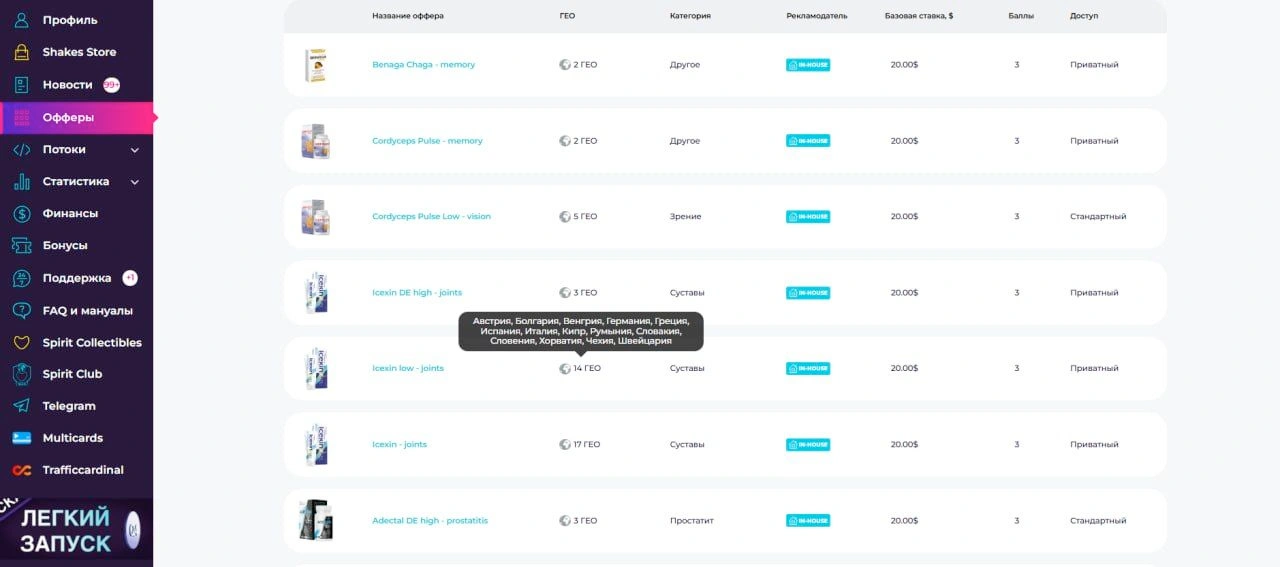
Example of an offer showcase in an Affiliate Network
Pay attention to:
- payout size
- GEO (countries where the offer works)
- allowed traffic sources
- lead quality requirements
- availability of landing pages and promotional materials from the affiliate network
It is better to talk to the affiliate program manager — they will tell you which offers are currently in the top and will suit your traffic.
Before launching, it is important to understand which model you will be paid by:
- CPA (Cost Per Action) — payment for a specific action (purchase, registration, installation).
- CPL (Cost Per Lead) — payment for a lead (confirmed application).
- CPC (Cost Per Click) — payment for clicks.
- RevShare (Revenue Share) — a percentage of the income brought by the attracted user.
- Hybrid — a combination of CPA + RevShare.
For the start, CPA or CPL are chosen more often — the result is visible faster, and it is easier to calculate ROI.
Step 3. Prepare the Funnel (Setup)
A funnel (often called a "bundle" or "scheme" in arbitrage) is the entire chain of user interaction with advertising: from the first contact to the execution of the target action. Usually, it looks like this: the ad attracts attention, the user goes to a landing page or an intermediate page (pre-landing), and then gets to the offer itself.
At this stage, it is important to prepare several variants of creatives — images or videos together with texts, which will be tested in various combinations. It is also necessary to choose a ready-made landing page from the affiliate network or create your own page that will warm up the user's interest in the offer. A mandatory part of the preparation is setting up tracking to monitor clicks, conversions, and understand which elements of the funnel bring results and which drain the budget.
Beginners often ignore analytics and launch advertising "blindly". As a result, money is spent, but it is impossible to determine at what stage the user is lost.
Step 4. Run Tests
The first launch in arbitrage is data collection and understanding audience behavior. At this stage, it is important to test several creatives, different audiences, or placement platforms, as well as work with a small budget to reduce risks.
The task of the test is to find a working combination of funnel elements: determine where users click more often, where they perform target actions better, and in which variant the cost of the target action is lower. It is the test results that provide the basis for further optimization and scaling.
Step 5. Analyze and Optimize
After the start, the main work begins:
- turn off unprofitable ads;
- strengthen those that give results;
- test new creatives and approaches;
- monitor metrics (CTR, CR, CPA, ROI).
It is at the optimization stage that arbitrage turns into systematic work.
Traffic Sources for Arbitrage
In arbitrage, a traffic source is a channel from which users are attracted to the advertising funnel (to a landing page, intermediate page, or directly to the offer).
All sources can be divided into paid and conditionally free (organic). The earning principle is the same — monetization of user actions, but the method of obtaining traffic differs: either direct advertising expenses or investment of time, content, and resources.
Paid Traffic Sources
These are channels where traffic is bought directly. They allow you to quickly get large volumes of traffic but require a budget and are associated with the risk of losing money.
1. Social Networks (Targeted Advertising)
Facebook, Instagram, TikTok. Advertising in social networks allows you to precisely target audiences by interests and behavior. This is a convenient source for tests and scaling, but there are moderation restrictions and the risk of account bans for violating platform rules.

Example of advertising on Facebook
2. Search Advertising
Works with formed demand: the user is already looking for a solution, so they are more inclined to perform the target action. Disadvantages — difficult to master, high competition, and cost per click (e.g., Google Ads (Search), Microsoft Ads (Bing), Yandex Direct).
3. Native Advertising
Ads look like part of the content on media platforms. Gives large volumes but requires competent presentation and testing of many creatives (e.g., Taboola, Outbrain, MGID, Revcontent).
4. Ad Networks and Programmatic Advertising (Banners, Video, RTB)
Allow working with different formats and volumes, however, require filtering of platforms and traffic quality control (e.g., Google Display Network, DV360, The Trade Desk, Adform, Criteo).
Push, in-page, pop, and redirect are online advertising formats that the user sees while browsing websites. These can be pop-up windows, browser push notifications, ad blocks inside the page, or automatic redirection to an advertising site after clicking on an element on the page.
Such formats usually provide large volumes of traffic and a relatively low cost per click. They are more often used for offers where the decision is made quickly, however, traffic quality depends heavily on campaign settings and the specific platform. Among proven networks are PropellerAds, RichAds, Zeropark, Clickadu, Adsterra.
5. In-app and Mobile Traffic
Traffic from apps and mobile networks is well suited for mobile offers (including apps from gambling affiliate programs) and GEOs with a high share of mobile users. Among the most popular networks are Unity Ads, AppLovin, ironSource, Mintegral, Google App Campaigns, Moloco DSP.
6. Influencers and Community Placements
Buying ads from bloggers, in Telegram channels, and communities is also paid traffic, heavily dependent on audience engagement and the relevance of the offer to the platform (e.g., Instagram bloggers, YouTube integrations, buying in Telegram channels, seeding in VK communities).
7. Email Marketing
Can be both paid placement in other people's databases and working with your own audience. Effective, but requires a high-quality database and compliance with mailing service rules (e.g., Mailchimp, SendGrid, GetResponse, UniSender).
Organic and Free Traffic Sources
Conditionally Free Traffic (Organic) is attracting users without directly buying advertising. Instead of an advertising budget, the main resources become time, content, and work with accounts. The arbitrageur's task is to understand how recommendation and ranking algorithms work on the platform and ensure that content gets reach and impressions for free.
In practice, it looks like this: a large amount of content is created (videos, posts, profiles, comments), often work is carried out with several accounts simultaneously. Part of the materials gets into recommendations, due to which traffic appears, which is led via a link in the profile to a landing page or directly to the offer. Example: recently, the format of driving traffic using short videos in Telegram has gained great popularity. The advertiser pays the arbitrageur a commission for each attracted subscriber.
Another option is working with an existing audience on target platforms: for example, interacting with users in communities, on forums, or in dating apps and transferring communication to messengers or social networks where the offer is proposed. In the last two years, clips from streams have been popular — you can get rewards for them using the CPM model: for views. In both cases, money is not paid directly for advertising.
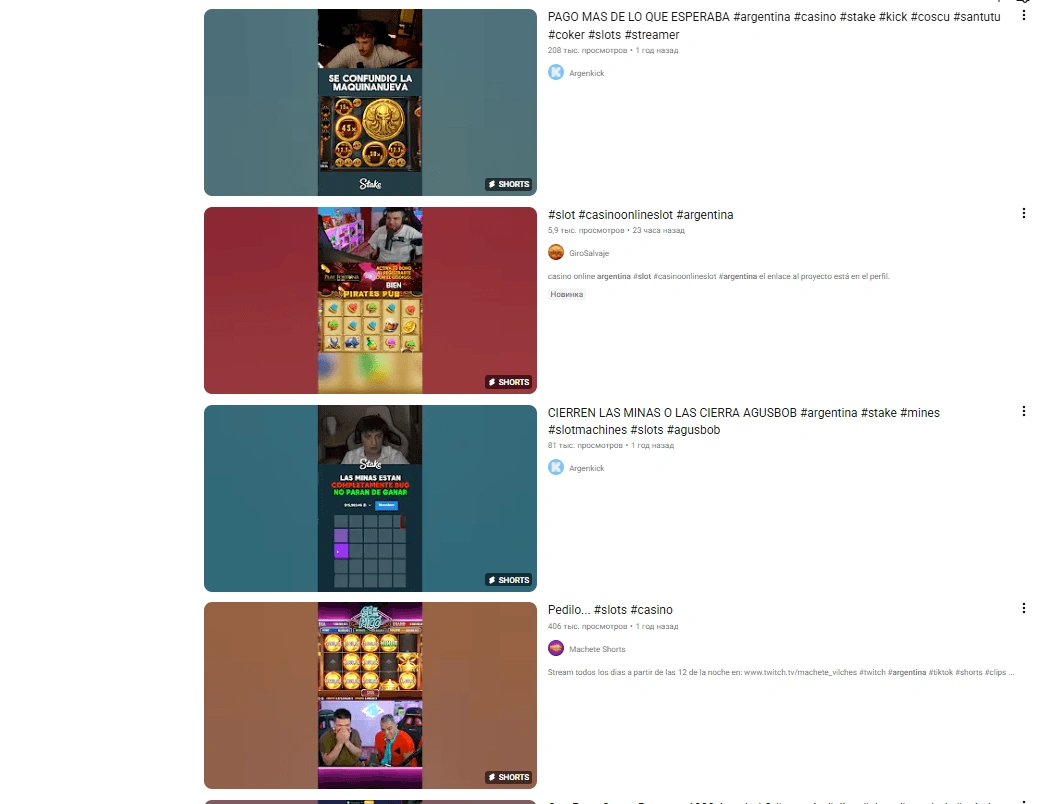
Examples of arbitrage videos on YouTube
SEO (Organic Search). Traffic from search engines is obtained by promoting a website to high positions in search results for target user queries. To do this, content on the topic is created, and technical and content optimization of the site is carried out. The channel is long-term, but with proper work, it can provide a stable flow of target users without direct advertising costs (e.g., Google Search, Bing, Yandex Search).
ASO (Organic in App Stores). Suitable for working with applications — optimization of cards in stores allows you to get installations without direct advertising costs (e.g., App Store, Google Play, Huawei AppGallery).
Forums, Communities, and Crowd Marketing. Working through discussions and recommendations can provide high-quality traffic but requires careful, native presentation (e.g., Reddit, Quora, thematic Telegram chats).
Classifieds and Bulletin Boards. In certain verticals, such platforms can provide a stable flow of target users (e.g., Avito, OLX, Craigslist, Youla).
How to Choose a Suitable Source
The main principle is the correspondence between the offer and the interests of the audience. Each traffic source has its own characteristics and requires experience to obtain good results. Somewhere more budget is required, somewhere time, and somewhere strong technical savvy. Search traffic works better with conscious demand, social networks give scale, native advertising is suitable for gradually increasing audience interest, push and pop give large volumes, and organic traffic saves budget but requires significant time and resource costs.
How to Choose an Offer for Arbitrage
Choosing an offer is selecting a proposal that fits your traffic source, audience, and work format. Even strong creatives won't save you if the offer doesn't match the target audience or isn't suitable for the platform. Therefore, compatibility is assessed first, and only then potential profit.
First of all, you need to understand where you will attract traffic from and what advertising format you will use. The same offer can work well in social networks and fail in search, or vice versa. It is important to make sure that the selected source is allowed by the terms of the affiliate program, and the audience is genuinely interested in the product.
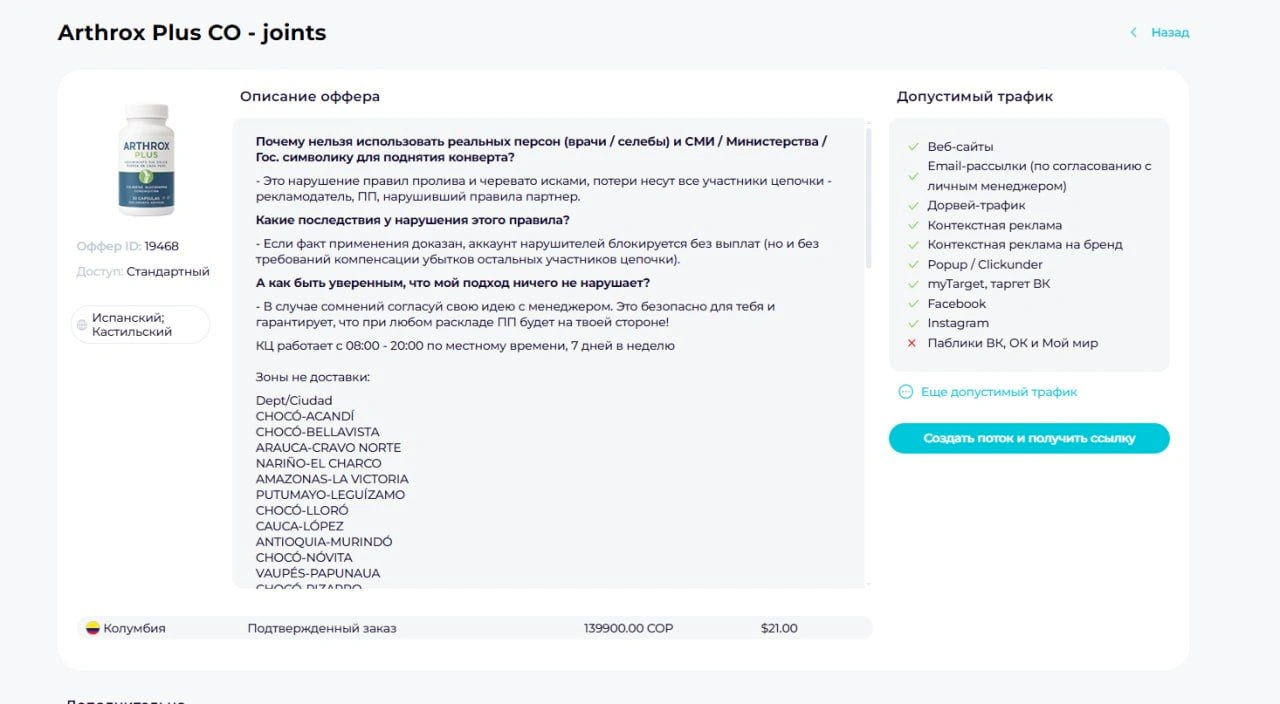
Example of an offer description
Next, you need to carefully study the terms of the offer. The description always indicates which action is considered the target (for example, purchase, registration, or application), in which countries the offer works, whether there are restrictions on traffic types, and what requirements are imposed on lead quality. It is also important to consider the hold — the period for checking leads before payment — and possible limits on traffic volume. These details directly affect the speed of return on funds and the possibility of scaling.
The financial side of the offer is assessed not only by the payout size. Efficiency indicators are much more important: EPC (Earnings Per Click) — average earnings per click, CR (Conversion Rate) — percentage of users who performed the target action, AR (Approval Rate) — share of confirmed leads.
A high rate may look attractive, but if users convert poorly or applications are often rejected, the funnel will turn out to be unprofitable.
It is also worth considering the practical side of working with the offer. The availability of ready-made landing pages, creatives, and audience recommendations from the advertiser facilitates the start, and the correct transfer of conversions to the tracker allows analyzing advertising effectiveness. Support from the affiliate network manager is especially important for beginners, as it helps avoid technical and strategic mistakes.
Which Monetization Model is Suitable for the Start
At the start in arbitrage, it is important to quickly receive clear feedback on results. A beginner needs to see which actions bring income, where users are lost, and how much a lead actually costs. Therefore, the monetization model should be chosen based on how easy it is to test, calculate, and control.
For beginners, models with fast turnover and transparent economics are better suited. They allow you to understand the logic of the process faster and reduce the impact of uncertainty. More complex models can be more profitable in the long run but require experience, analytics, and stable traffic quality.
Comparison of Models for the Start
| Model | How Payment Occurs | Pros for a Beginner | Main Risk |
|---|---|---|---|
| CPA | For a specific user action | Result is visible quickly, easy to calculate ROI | Need to hit the target audience |
| CPL | For an application or contact | Similar to CPA, usually easier to get a conversion | Lead quality can affect payment |
| CPC | For clicks | Simple launch, clear mechanics | Clicks do not guarantee income |
| RevShare | Percentage of user income | Potentially high long-term income | Income not immediate, hard to forecast |
| Hybrid | Fixed payout + percentage | Balance of short-term and long-term income | Requires experience and stable traffic |
The main rule for the start is to choose a model where you will quickly see the result of your actions and be able to promptly adjust advertising. When experience and stable funnels appear, you can connect models with a share of revenue to increase profit over the distance.
Setting Up Tracking and Analytics
In traffic arbitrage, tracking is the foundation of all work. Without it, it is difficult to understand what exactly brings profit, which creatives work, and which simply drain the budget.
Tracking allows you to monitor the user's path from clicking on an ad to performing the target action. The system records where the person came from, through which ad, from which device, from which country, and whether this transition led to a conversion. Thanks to this, the arbitrageur sees the effectiveness of each element of the funnel.
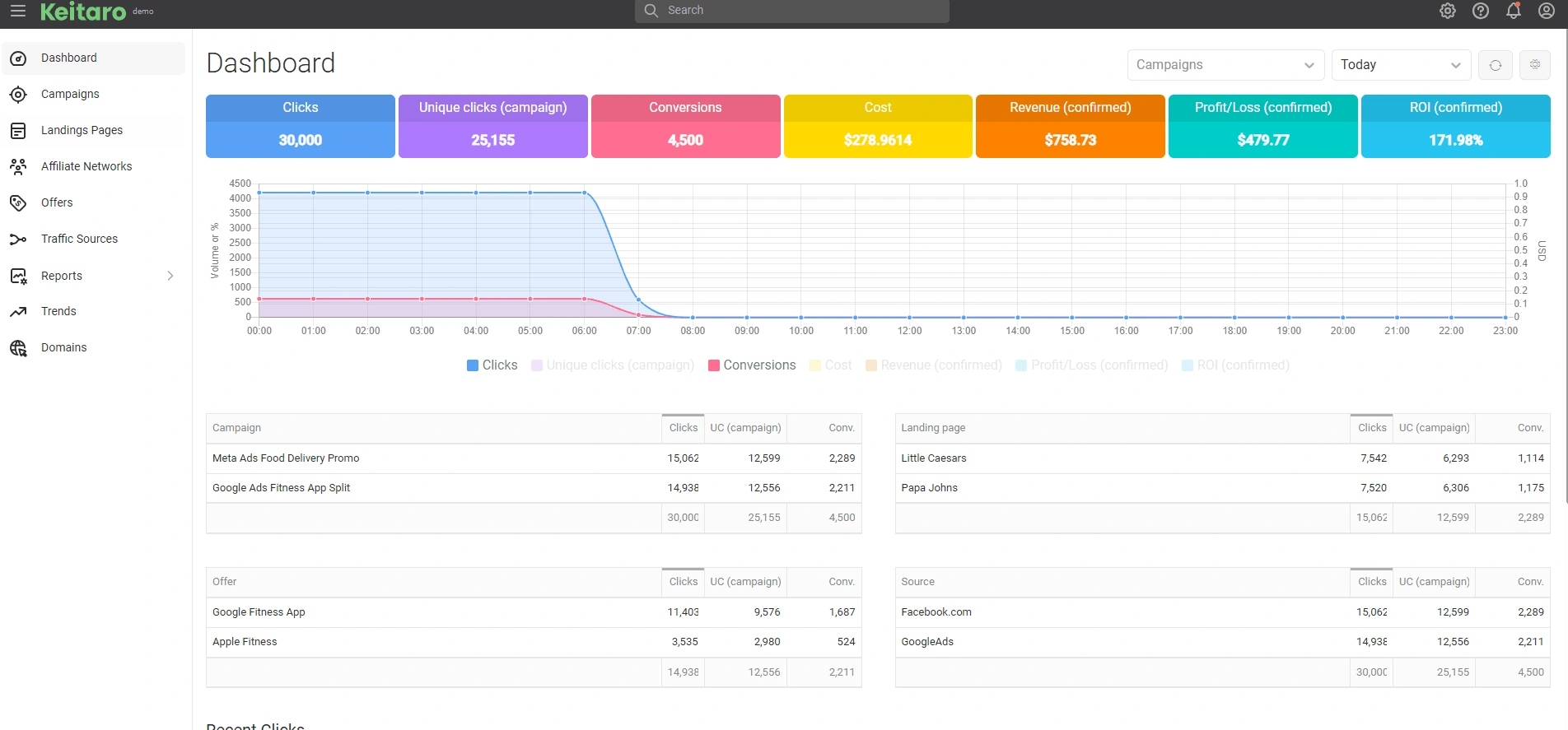
Keitaro tracker dashboard
Usually, special trackers are used for this. They link the traffic source and the affiliate program by transferring conversion data. When a user performs a target action, information about this returns to the tracker, and you see exactly which ad brought the result.
It is especially important to track not only the total profit but also intermediate indicators: number of clicks, cost per click, conversion, cost per action, and ROI. It is these data that allow you to turn off unprofitable ads in time and strengthen those that bring target actions (applications, purchases, registrations).
Intermediate Metrics: ROI, CR, EPC, and Others
Intermediate metrics help understand what is happening inside the funnel: where users are lost, at what stage advertising becomes unprofitable, and how to get into the black. These indicators allow you to manage advertising.
The most important metrics that every arbitrageur should understand:
| Metric | What It Means | Why It Is Needed |
|---|---|---|
| CR (Conversion Rate) | Percentage of users who performed the target action | Shows how well the offer and funnel convert traffic |
| EPC (Earnings Per Click) | Average income per click | Helps calculate the maximum profitable price per click |
| CPC (Cost Per Click) | Cost of one click on an ad | Basic expense indicator |
| CPA (Cost Per Action) | Cost of obtaining one action | Shows the real price of the result |
| ROI (Return on Investment) | Return on investment | Main profitability indicator |
These metrics work in conjunction. For example, a high EPC allows you to withstand a more expensive CPC, and a good CR reduces the final CPA. If ROI goes into the negative, the task is to find which of the intermediate metrics has sagged: poor clicking (low CTR), poor traffic conversion (low CR), or clicks are too expensive (high CPC).
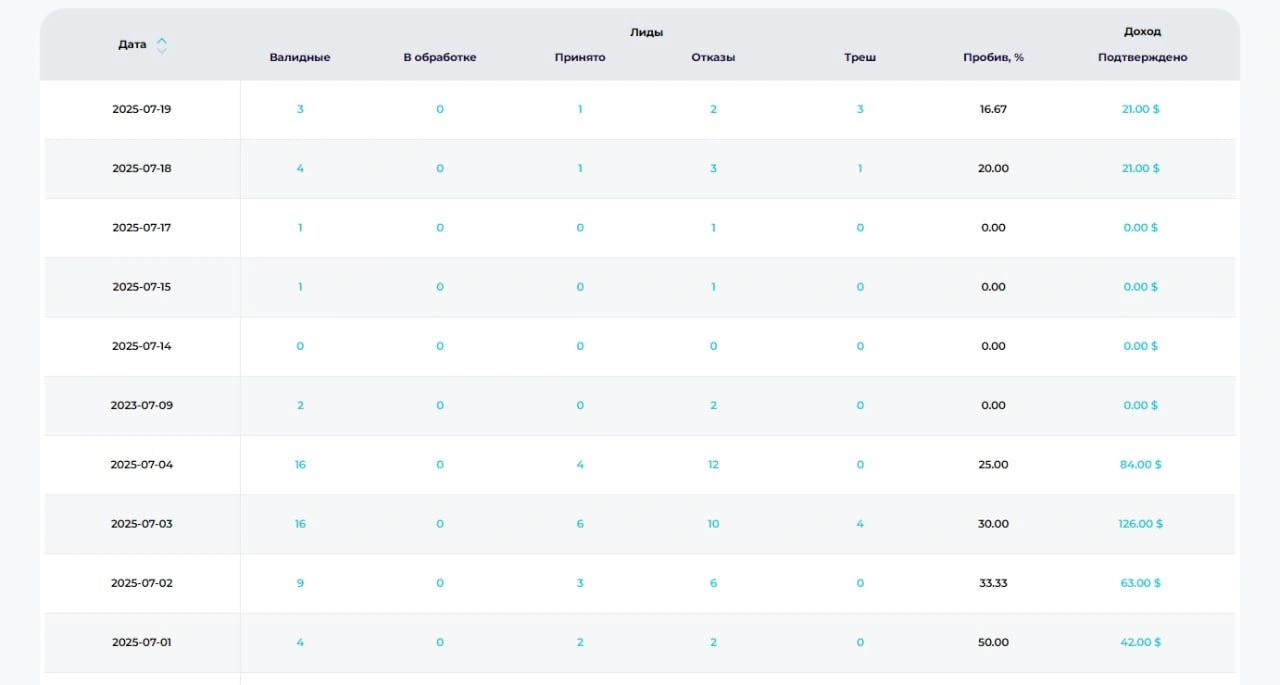
Example of statistics in the Affiliate Program personal account
It is important to remember that unprofitable indicators at the test stage are normal. The task of intermediate metrics is to show data for optimization: what to turn off, what to change, and what to scale.
Mistakes Beginners Make in Traffic Arbitrage
At the start in arbitrage, most losses occur due to typical mistakes. Beginners often rush to launch, try to earn faster than they have time to figure out the numbers and processes, and as a result, drain the budget where useful data and experience could have been obtained.
Here are the most common mistakes:
- Launching without calculating economics. An offer with a high payout is chosen, but the allowable cost per click and target action is not calculated. As a result, even good traffic becomes unprofitable.
- Working without tracking and analytics. Money is spent, but it is unclear which ads bring results and which drain the budget. Without data, it is impossible to get a stable result.
- Blindly copying other people's funnels. What works for another arbitrageur may not suit your traffic source, audience, or offer conditions. Without your own tests, this almost always leads to a loss.
- Scaling too early. A first profit appeared — the budget is sharply increased. On large volumes, an unstable funnel quickly goes into the negative.
- Ignoring platform and offer rules. Violations of moderation requirements or the use of prohibited approaches lead to account bans and refusal to pay for leads.
The sooner a beginner starts treating the process as analytical work, the higher the chance of getting into a stable profit.
How to Minimize Risks at the Start
Traffic arbitrage is always associated with uncertainty: you work with advertising, algorithms, audiences, and offers where the result cannot be guaranteed in advance. But risks can be controlled. The beginner's task is to make them non-critical for the budget.
Basic principles of risk reduction at the start:
- Start with small budgets. The first stage is tests. Small budgets allow you to get data without serious financial losses.
- Test gradually. Change one element of the funnel (creative, audience, or landing page) per test to understand exactly what affects the result.
- Record test results. Keeping a simple record of launches helps not to repeat the same mistakes.
- Always use tracking and analytics. Without numbers, it is impossible to understand exactly where the problem arises. Tracking reduces the risk of blindly draining the budget.
- Choose understandable offers and payment models. Complex schemes and long-term monetization models increase uncertainty. At the start, it is easier to work with what shows results faster.
- Observe the rules of platforms and affiliate programs. Account bans and refusal to pay for leads are one of the most significant risks for a beginner.
- Do not enter arbitrage with your last money. Psychological pressure prevents making rational decisions and leads to hasty actions.
Minimizing risks in arbitrage is about systematicity. The more manageable the testing process becomes, the faster chaotic launches turn into predictable work.
Budget: How Much Is Needed to Start Arbitrage
In traffic arbitrage, there is no single fixed amount for the start — the budget depends on the traffic source, selected vertical, monetization model, and your testing strategy. However, there are guidelines that help plan the start.
When working with paid traffic, the minimum budget often starts from $150–300. This amount may be enough for the first test in inexpensive sources to understand the launch mechanics and obtain basic data. However, it is difficult to count on stable profit with such a budget — this is rather a learning stage.
A more realistic range for the start is considered to be $500–1,000. Such a budget allows you to test several hypotheses, audiences, or creatives, connect tracking, and obtain a sufficient amount of data for analysis.
If we are talking about working in expensive advertising sources and the possibility of scaling, a budget of $1,000–2,000 and higher is often mentioned. This gives a margin for optimization and conducting a full cycle of tests.
When using organic traffic, financial investments can be significantly lower, since traffic is attracted through content, social networks, or video platforms without direct purchase of advertising. However, in this case, the main resources become time, regular work with content, and account management.
It is important to understand that the indicated amounts are guidelines for testing, not a guarantee of income. The smaller the starting budget, the slower the data accumulates and the longer the path to a stable funnel.
Tools and Services for an Arbitrageur
For traffic arbitrage to work as a system, special tools are needed. They help analyze data, find working approaches, manage advertising accounts, create creatives, and quickly launch new funnels. Without these services, efficiency decreases, and the risk of draining the budget increases.
Below are the main categories of tools used in arbitrage.
| Category | What It Is Used For | Examples of Services |
|---|---|---|
| Trackers and Analytics | Tracking clicks, conversions, traffic sources, and funnel effectiveness | Keitaro, Voluum, Binom, RedTrack |
| Spy Services | Analyzing competitors' ads, searching for working creatives and approaches | AdPlexity, SpyOver, BigSpy |
| Anti-detect Browsers | Managing multiple advertising accounts with different digital fingerprints | Linken Sphere, Dolphin Anty, Octo Browser |
| Proxies and VPNs | Working with different GEOs and IP addresses, reducing the risk of blocking | Proxy-Seller, Geonix, Nord VPN |
| Tools for Creatives | Creating images, videos, and banners for advertising | Canva, CapCut, Photoshop, Neural Networks |
| Virtual Card Services | Paying for advertising and foreign services | Capitalist, FlexCard, Pay2.House |
A tracker is the basis of the technical part of arbitrage. It links the advertising source and the affiliate program, shows which advertising brings conversions, and helps find unprofitable elements of the funnel. Without tracking, it is impossible to fully manage advertising.
Spy services save time and budget on tests, allowing you to see what formats and creatives are already being used in the market. This does not guarantee a result but gives direction for hypotheses.
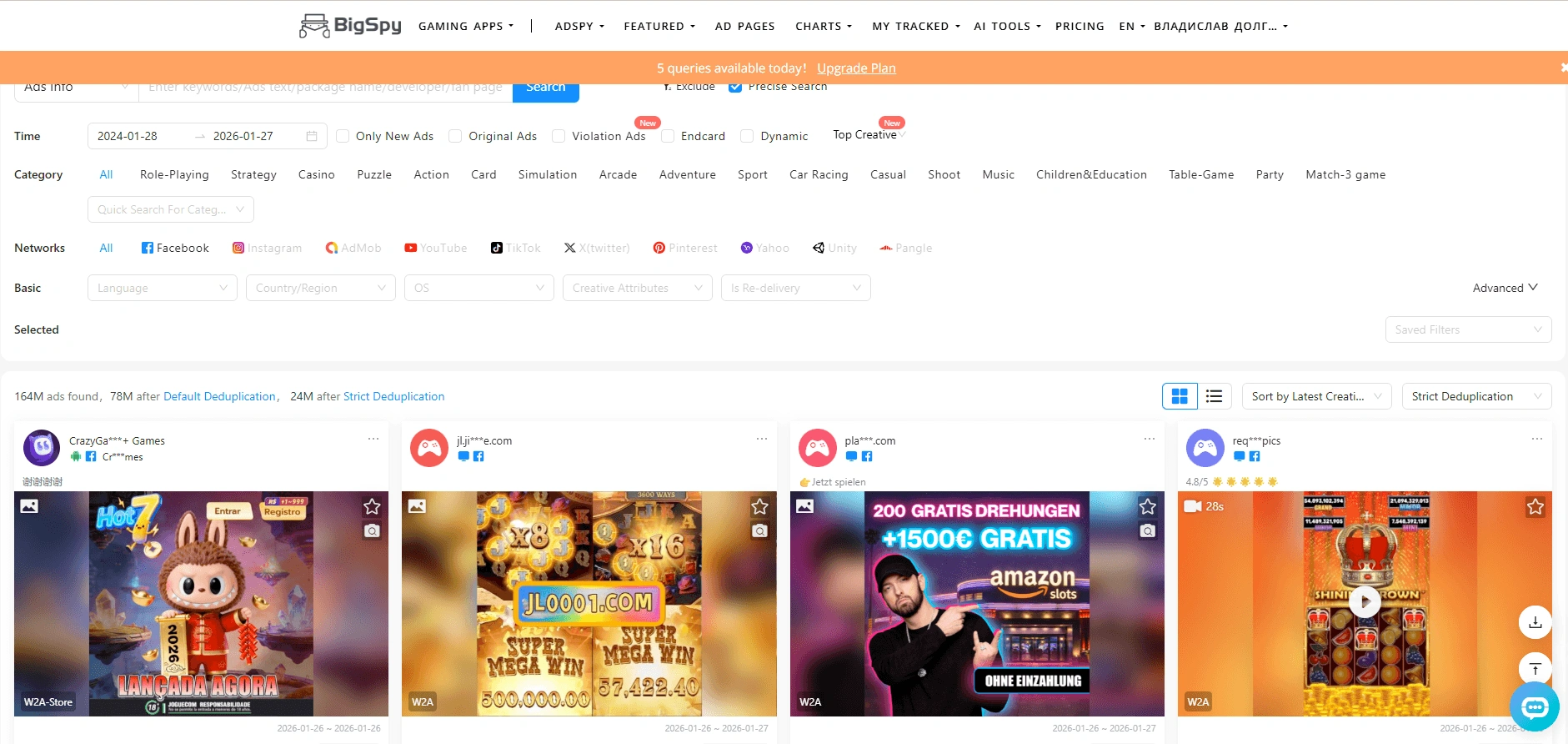
Example of a spy service
Anti-detect browsers, proxies, and VPNs are used for safe work with advertising accounts and different GEOs.
Services for creating creatives and landing pages directly affect conversion. Even with good traffic, weak visual presentation can kill a funnel, so content tools are no less important part of the arbitrage kit.
At the start, it is not necessary to use the entire set of services. Usually, they start with a tracker, a tool for creating creatives, and an anti-detect browser, gradually expanding the infrastructure as volumes and tasks grow.
Conclusion
Traffic arbitrage is systematic work with numbers, tests, and optimization. Profit comes only when the funnel (offer + source + creative) accurately hits the audience, and the arbitrageur controls the economy through tracking and metrics. Both paid traffic and organic traffic work on the same principle — the difference is only in the resources you invest. The main success factor here is analytics, discipline in tests, and the ability to scale what has already proven its payback.
Frequently Asked Questions
Yes, many beginners enter arbitrage without a technical background, but success depends on the willingness to understand analytics, test funnels, and work with numbers. This is a field where results are built on tests.
There is no ceiling, but income is unstable. In arbitrage, there is no fixed salary — earnings depend on a working funnel, traffic source, offer, and the ability to increase traffic volumes and the number of clicks. Some reach an income of several tens of thousands of rubles a month, experienced arbitrageurs work with turnovers of hundreds of thousands of dollars and higher. But unprofitable periods are also possible.
It depends on the traffic source. When working with paid advertising, usually $300–500 is allocated for tests to get the first data. In organic traffic, the financial threshold is lower, but more time, content, and work with accounts are required.
Due to a lack of analytics and discipline. The main reasons are launching without calculating economics, working without tracking, copying other people's funnels without understanding the logic, scaling too quickly, and ignoring platform rules. Arbitrage is systematic work with metrics.