Mobile Proxies — When It's Best to Choose Them

In many online tasks, proxies have already become a standard tool — without them, it is harder to work anonymously and avoid restrictions from services. This applies to traffic arbitrage, social media automation, web scraping, ad verification, multi-accounting, and other tasks where exposing your main IP address is undesirable.
One of the most popular types of proxies today is mobile proxies. They work through the IP addresses of mobile operators, which is why they are less prone to blocking, unlike data center solutions.
In this article, we will break down how mobile proxies work, how they differ from other types, where they are used, and how to choose a reliable provider.
Why Mobile Proxies Are Better Than Other Types of Proxies
Mobile proxies are proxy servers that use the IP addresses of 3G/4G/5G mobile operators. Externally, such traffic looks like the connection of a regular user from a smartphone or tablet.
Mobile IPs are valued due to the specific nature of such networks. A single address is often used simultaneously by many subscribers through NAT/CGNAT — a mechanism that translates the internal IP addresses of devices into one external IP. Therefore, platforms rarely block such addresses: along with suspicious traffic, they could accidentally restrict access for thousands of regular users.
Features of Mobile Proxies
- More trust from platforms. Traffic through mobile proxies passes through the IP addresses of mobile operators, so to anti-fraud systems, it looks like the regular activity of smartphone users. This does not provide complete protection against blocking, but such addresses generally arouse less suspicion than data center ones. Additionally, data transmission over cellular networks often has built-in encryption protocols, adding an extra layer of security to your work.
- IP rotation and session management. Many mobile proxies support changing the IP address. This can be done via API, a special link, a timer, or with each new connection. Thanks to this, a single proxy port can sequentially issue different mobile IPs from the operator's pool. This allows you to imitate regular internet users and reduces the risk of bans from websites and advertising platforms.
- Precise geolocation targeting. When working with mobile proxies, you can choose the country, and sometimes the city and mobile operator. This is convenient for tasks where it is important to appear as a user from a specific location.
- Connection stability. Mobile proxies work through the networks of telecom operators. In a number of tasks, such a connection can be more stable than regular residential IPs, especially when constant address changing and working through mobile infrastructure are important.
But there are also downsides. Mobile proxies are more expensive than data center ones, and the connection speed can be lower. When paying per traffic, they are also not always suitable for tasks involving large volumes of data.
Where Mobile Proxies Are Indispensable
Mobile proxies are actively used in many scenarios. Let's break down the most common ones.
- Traffic arbitrage. When launching campaigns on Facebook Ads, Google Ads, or TikTok Ads, algorithms detect account farms at the registration stage. Mobile IPs provide the necessary level of trust for warming up profiles and linking payment methods without triggering document verification checks.
- Social media management. Mass following, bulk messaging, managing networks of Telegram channels, or boosting profiles on crypto exchanges (to participate in retro drops) are practically impossible without reliable proxies. Mobile IP addresses imitate the actions of real people from phones in different geolocations.
- SEO, web scraping, and data collection. Scraping search engine results, collecting semantic cores via specialized software, or analyzing competitors require a constant change of clean IP addresses to avoid battling CAPTCHAs. The rotation of mobile addresses solves this problem.
- Verifying ads, landing pages, and offers in different GEOs. Mobile proxies allow you to open pages using the IPs of mobile operators from different countries. This is convenient for checking ads, landing pages, and affiliate offers in the required regions.
- Online privacy. Sometimes mobile proxies are used simply to avoid exposing one's main IP when working with various services.
5 Best Mobile Proxy Providers
Below is a detailed overview of top services. We selected the providers based on real reviews from practitioners, the level of technical support, and the stability of their work. Additional reliable services can always be found in trusted directories.
Proxy-Seller
Proxy-Seller is a large infrastructure provider focused on selling classic private ports for specific work tasks and volumes.
Key metrics:
- Network geography. Over 20 countries, including the most in-demand locations: the USA, the UK, EU countries, the CIS, and Asia.
- Proxy type. Dedicated and Shared mobile proxies.
- Price. From $40 per month for a shared port and from $110 for a dedicated one. The final price depends on the selected GEO and the rental period.
- Features. The provider issues a fully private channel strictly to one user. You can choose a specific telecom operator (for example, T-Mobile or Vodafone). Traffic is unlimited, and IP address rotation is supported via a convenient HTTP request or timer.
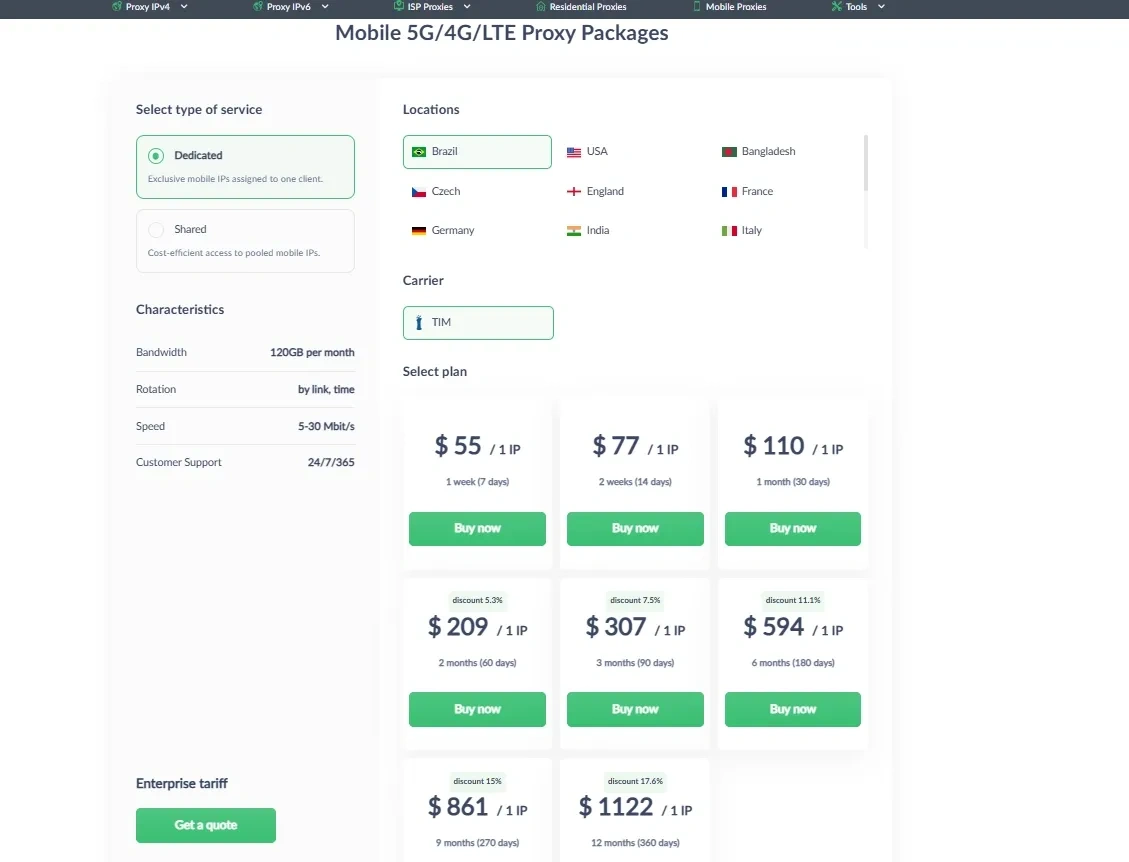
Clients highly rate the service for its connection stability, choice of GEOs for any task, and fast, responsive support. Disadvantages usually include the high cost of dedicated ports for popular Western locations when purchasing in small volumes.
MobileProxyNow
MobileProxyNow is a popular mobile proxy service. The platform features dedicated IP addresses on 4G and 5G networks. The provider uses the infrastructure of mobile operators.
Key metrics:
- Network geography. The provider focuses on the most in-demand but technically complex Tier-1 countries: the USA, the UK, and Germany.
- Proxy type. Dedicated mobile proxies based on 4G and 5G networks.
- Price. Proxies from Germany — $54 per month, from the UK — $59, from the USA — $79.
- Features. At MobileProxyNow, each proxy is issued to a single user. The same IP address is not used by multiple clients simultaneously. The proxies work through the real mobile networks of telecom operators. The service supports IP address rotation. IP changes can be performed manually, via an API request, or automatically at a set time interval.
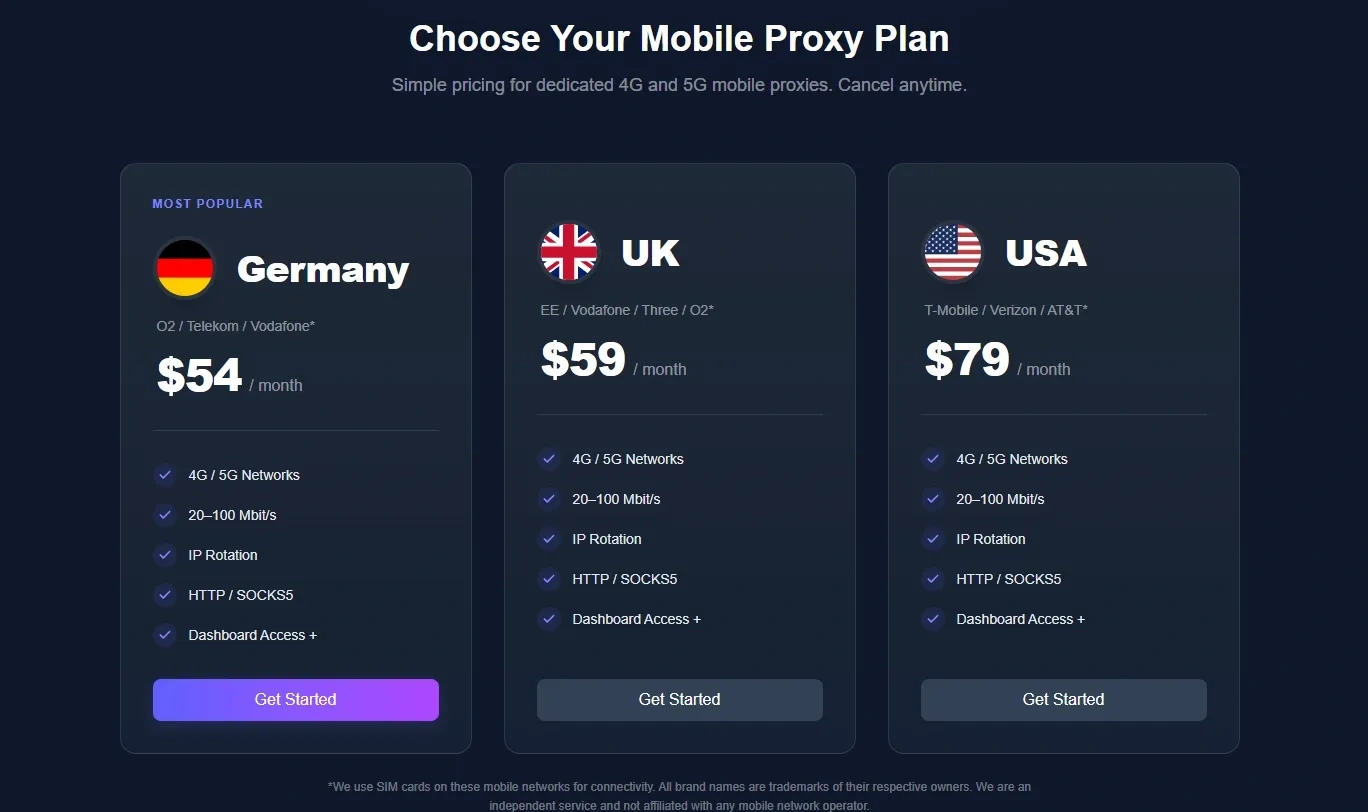
Users choose MobileProxyNow for working with the most demanding anti-fraud systems in Western GEOs. The service is suitable for mass account registration, social media management, traffic arbitrage, and data collection. Relative disadvantages include the lack of cheap or exotic locations, as the service focuses primarily on the quality of IP addresses in the Tier-1 segment.
AstroProxy
AstroProxy is a high-tech platform that focuses on dynamic routing and huge address pools worldwide. It is perfectly suited for tasks requiring frequent GEO changes.
Key metrics:
- Network geography. Mobile devices from over 100 countries worldwide.
- Proxy type. Dynamic mobile proxies.
- Price. From $13.14 per 1 GB of mobile traffic, depending on the chosen billing model (Prepaid or Pay As You Go). Port access is paid additionally — from $0.1 to $0.3 per unit.
- Features. The service is tailored for automation and web scraping. It is the optimal choice for tasks where an unlimited channel is not needed, but a constant IP change is critical to bypass CAPTCHAs. Rotation is configured with maximum flexibility: the address changes by timer or with each new HTTP request. Before purchasing, you can take a proxy for a free test.
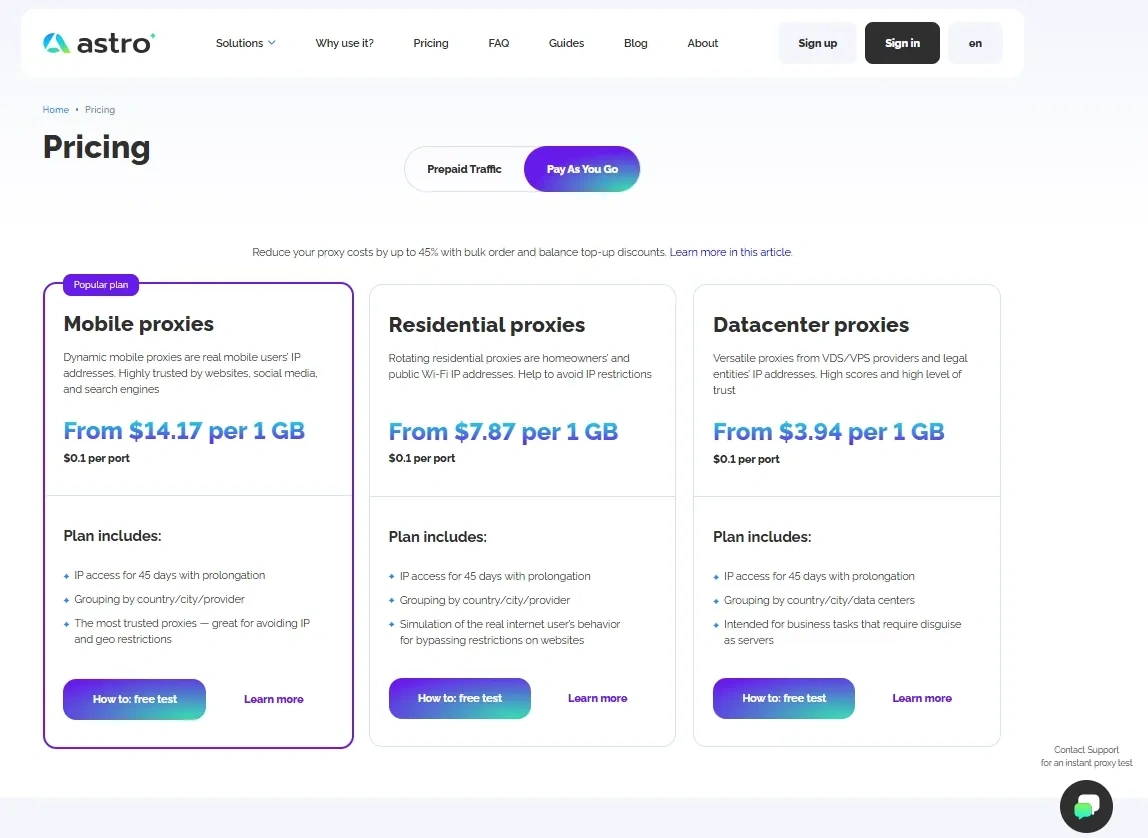
Users praise the service for its transparent payment system and powerful API integration. Among the downsides, they note the high cost for tasks with large volumes of traffic. For example, when scraping websites with a lot of media or working with video hosting platforms.
MobileProxy.space
MobileProxy.space is a popular service for renting private mobile proxies, focusing on flexible settings and providing unlimited access.
Key metrics:
- Network geography. Over 40 countries (widely represented are the CIS countries, Europe, the USA, as well as exotic locations).
- Proxy type. Dedicated mobile proxies.
- Price. Flexible pricing grid: you can rent a proxy for 1 day ($9), a week ($19), or a month (around $50, using Vietnam as an example location). Significant discounts apply when purchasing for a period of 3 to 12 months. A completely free plan is also available for testing the service.
- Features. A unique multiport function — right in your personal dashboard, you can change the country and mobile operator without extra charges or unnecessary support requests. The connection speed is not throttled, and traffic is not metered in any way.
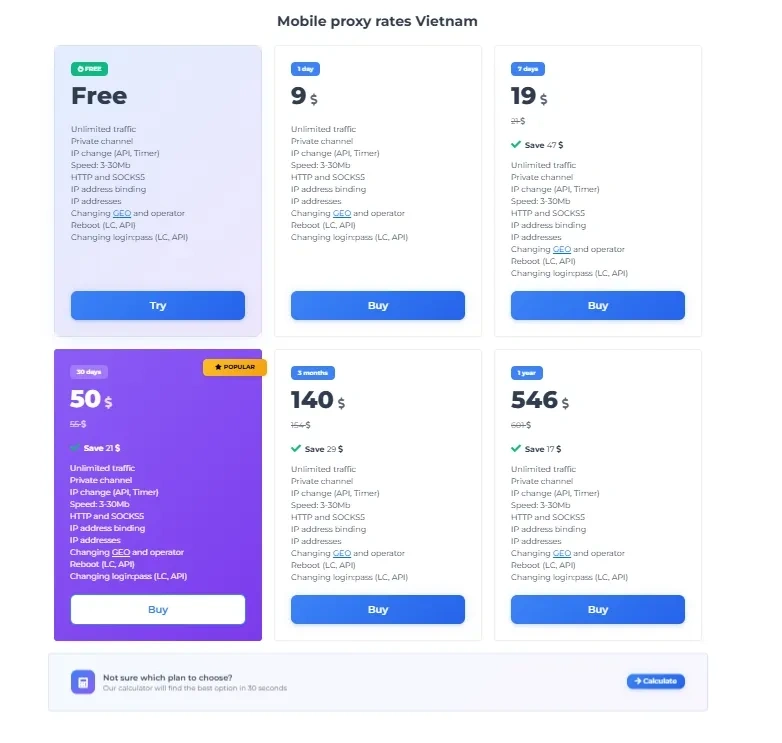
The service is highly valued by affiliate marketers for its flexibility (changing locations in a couple of clicks) and the availability of micro-plans (you can rent a proxy for 1 day). Occasionally, there are comments from users about speed drops in unpopular exotic GEOs during peak load hours.
Asocks
Asocks is a service with a maximally simplified billing model (Pay-as-you-go) for those who need mobile proxies for irregular, specific automated tasks.
Key metrics:
- Network geography. A huge pool of addresses from 150+ countries worldwide.
- Proxy type. Dedicated mobile proxies.
- Price. Two billing options. Unlimited mobile proxies will cost $15 per port per month (wholesale discounts up to 15% apply when purchasing 10 or more ports). For irregular tasks, there is pay-per-traffic — a single flat rate of $3 per 1 GB for any country.
- Features. Maximally simple and transparent billing. You do not pay for idle ports, gaining access to the entire network at once. The service provides a high degree of anonymity and issues exclusively "clean" IP addresses.
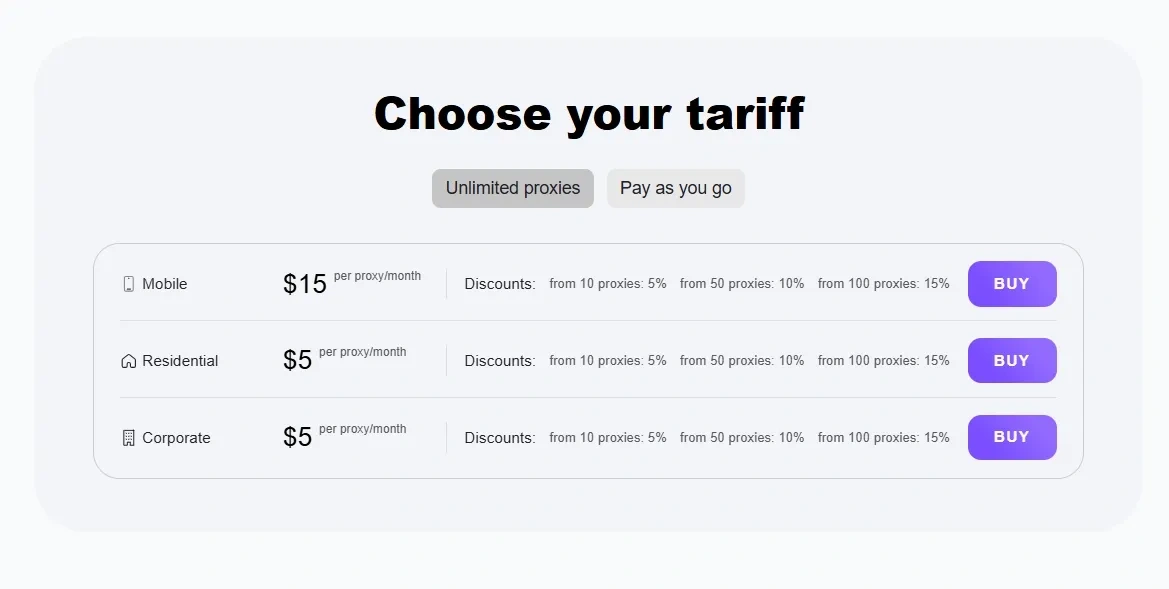
Users note the convenient control panel, the absence of subscription fees for unused ports, and the high level of anonymity. The main downside is standard for such models: the service is not suitable for downloading large files.
Alternative Solution
iProxy.online is a service with non-standard mechanics, focused on full control over the hardware. The application is installed on your own Android smartphone, turning it into a private mobile proxy node.
Key metrics:
- Network geography. Worldwide (depends entirely on which country the smartphone with the SIM card is physically located in). You can ask a friend to install the app and use their IP. Also, the website has a section with verified proxy sellers who are clients of the service.
- Proxy type. Mobile 4G/5G proxies on your own Android devices.
- Price. The cost of the software subscription is from $6 to $10 per month. Additionally, you pay the mobile operator's tariff for the SIM card.
- Features. Trust and privacy at the hardware level. You buy the SIM card yourself, so only you use the operator's IP pool — no "neighbors" on the port. Node management is fully integrated into a Telegram bot: through it, you can remotely change the IP address and monitor the smartphone's battery level so that the farm does not drop offline during operation.
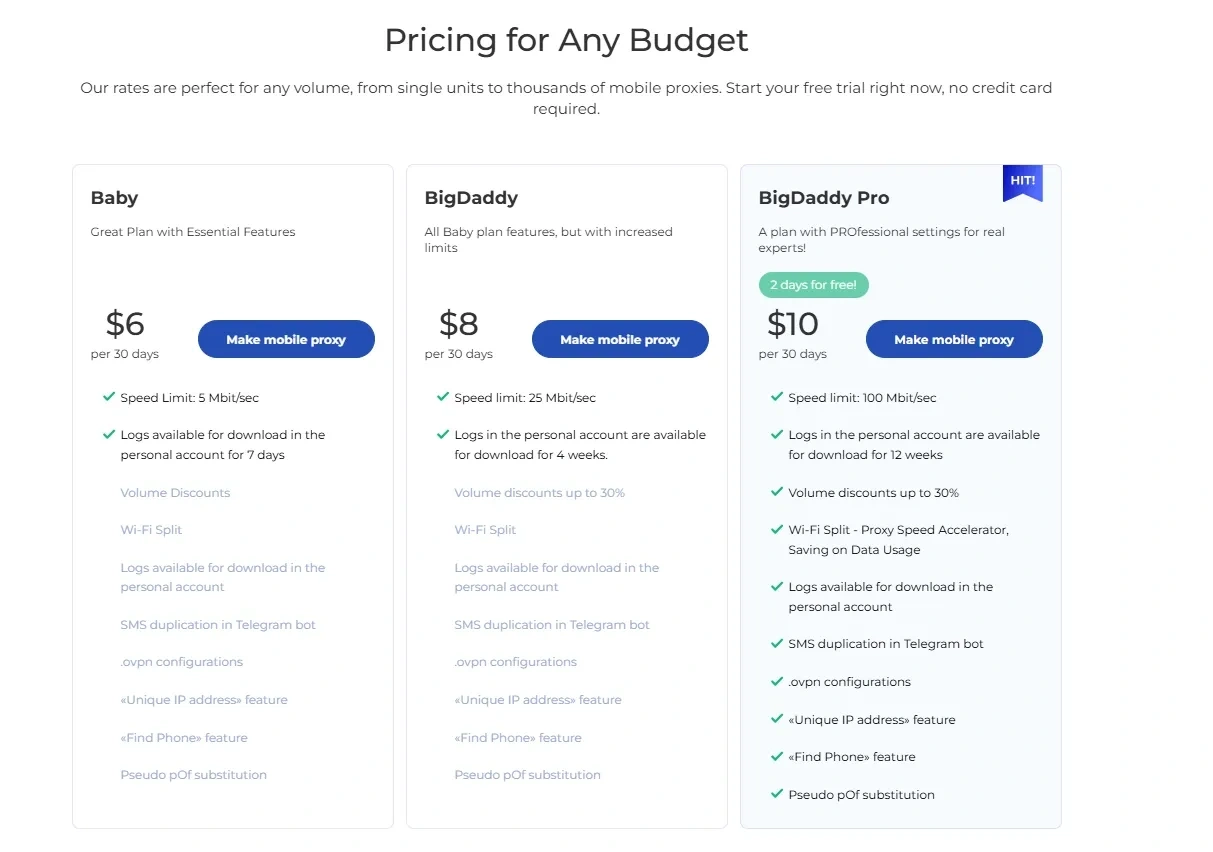
Users praise the service for its incredible cheapness and absolute privacy. Among the downsides, they note the need to have a separate physical smartphone constantly connected to the network and a charger.
How to Test Mobile Proxies
Buying a proxy is only half the battle. Even a private port does not guarantee complete cleanliness: the IP address might be in a subnet that has already been used for spam or mass registrations, and incorrect browser or software settings can reveal your real IP through leaks.
- Checking the network type (ASN). Make sure you haven't been sold server addresses disguised as mobile ones. Go to the IP2Location or Whoer website. The provider type should be strictly identified as ISP/Mobile or Cellular. If you see Hosting or DCH there, it is a server proxy that you should not work with.
- Evaluating Fraud Score (risk level). If a mobile operator's IP address is heavily spammed, platforms will treat it with suspicion. Go to Pixelscan or Scamalytics. For high-quality mobile networks, the score should be minimal (ideally from 0 to 15 out of 100).
- Checking for leaks. Traffic should not de-anonymize you through protocol vulnerabilities. Go to Browserleaks and check the DNS Leak and WebRTC sections. In all tests, the proxy's IP should be detected, not your real address.
- Dynamic rotation test. If you are using a port with rotation, copy the API link for changing the IP into your browser and navigate to it. Wait 10-15 seconds, refresh the page of the IP checking service (for example, 2ip) — your IP address should change.
Conclusion
Mobile proxies do not provide complete protection against blocking, but in many tasks, they help reduce its likelihood. This is especially noticeable where data center IPs quickly start receiving CAPTCHAs or restrictions from services.
The choice of provider depends on your tasks. Some services focus on private mobile ports and full control over the connection, while others emphasize wide geography, IP rotation, or pay-as-you-go traffic. Therefore, before purchasing, it is worth considering the payment model, available locations, and the specific infrastructure features of the service.
Frequently Asked Questions
Connect them to an antidetect browser and run them through an IP/ASN check, Pixelscan, WebRTC Leak Test, and DNS Leak Test. This is usually enough to identify basic issues with network type, leaks, and rotation.
The main alternatives are residential, ISP, and datacenter proxies. Residential IPs belong to regular home users and are well-suited for tasks where high address trust is important. ISP proxies provide a stable IP from an internet service provider and are often used for long-term account management. Datacenter proxies are faster and cheaper but are more easily detected by anti-fraud systems. The choice depends on your tasks: in some cases, residential or ISP addresses are sufficient, while for other scenarios, mobile IPs are a better fit.
They are more expensive than datacenter proxies. Connection speed and stability can be less predictable. With pay-per-traffic plans, the cost also increases quickly for data-heavy tasks. Additionally, a mobile IP alone does not guarantee protection against bans. If suspicious browser settings, a poor device fingerprint, or unnatural account actions (such as mass registrations, spam, or sudden geolocation changes) are used, the platform can still issue a ban.
Free mobile proxies are practically nonexistent. Some services offer trial access, but for continuous work, such options are usually too limited or unstable.