What is UDP and what role does it play in modern anti-detection browsers?
Introduction
In the multi-accounting industry, it is customary to pay close attention to fingerprint spoofing. However, the foundation of any network activity—transport protocols—often remains overlooked. While the global internet is mass migrating to HTTP/3 and QUIC standards, many tools ignore this progress, creating invisible but critical markers for anti-bot systems.
In this article, we will break down why UDP support in SOCKS5 is not a question of speed, but a mandatory condition for a high-quality digital portrait in 2025. We will explain the technical difference between protocols, teach you how to choose the right proxies, and show the results of our independent audit of popular anti-detect browsers. If you are already familiar with the theory, you can skip straight to the results of our research.
However, to form a complete picture and understand all the nuances of how modern communication channels work, we recommend reading the publication in its entirety.
Evolution of Protocols — Why TCP is No Longer Enough
To understand the value of UDP support, we need to go a level deeper—to the mechanics of data transmission on the internet.
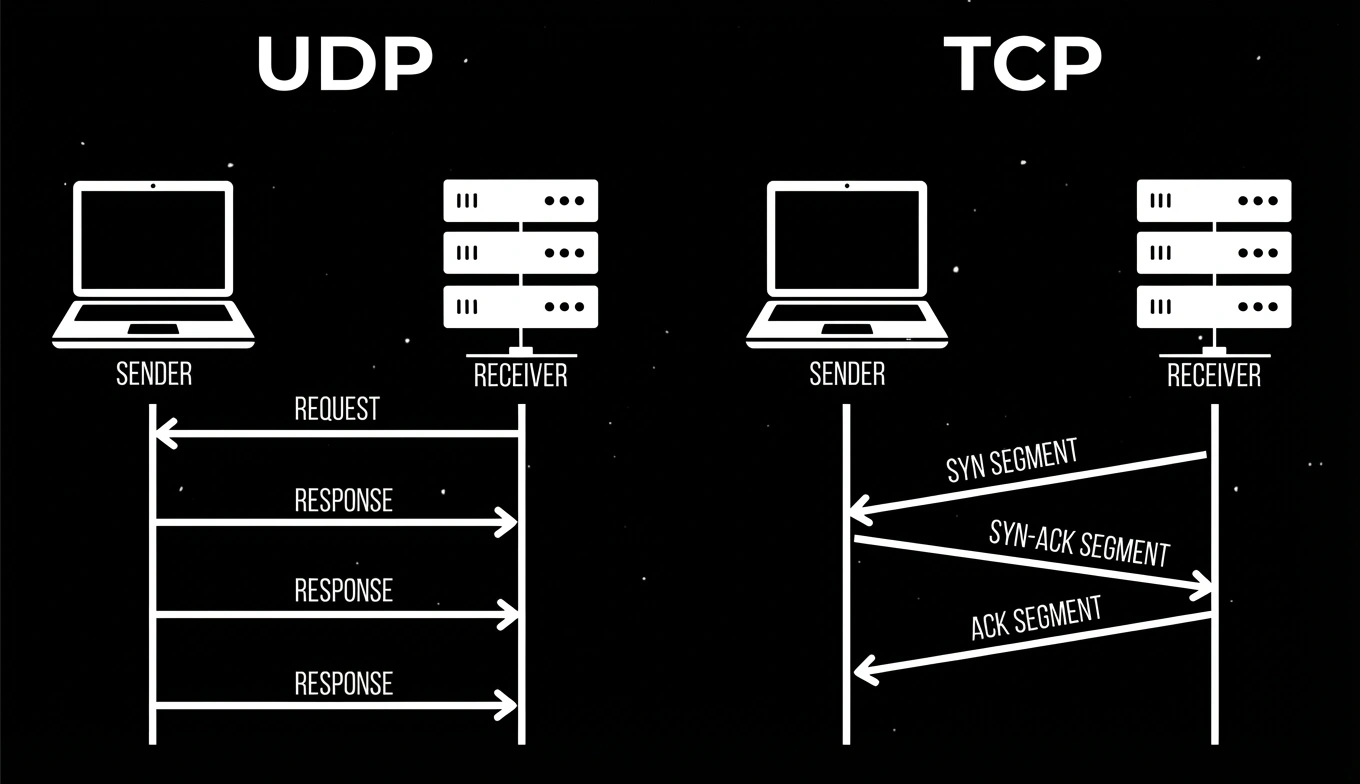
Globally, there are two main transport protocols: TCP and UDP.
- TCP (Transmission Control Protocol) is the classic, strict standard. It guarantees that all data reaches the recipient in the correct order. If a packet is lost along the way, TCP forces it to be resent. This is reliable, but slow due to constant checks and acknowledgments.
- UDP (User Datagram Protocol) is a protocol that works on the "fire and forget" principle. It doesn't waste time establishing heavy connections and confirming the delivery of every byte. This ensures maximum speed and minimum latency.
In the context of a browser, TCP was traditionally responsible for the reliable loading of page structures (HTML, CSS). However, the modern internet has changed. 4K video, instant interface reactions, and streaming require speeds that good old TCP cannot provide. Therefore, IT giants have started a mass migration to technologies built on top of UDP.
If your proxy (and, consequently, your browser) does not know how to work with UDP, you automatically cut yourself off from a huge layer of modern web technologies. To an anti-bot system, it looks as if you arrived in 2025 with equipment from 2010.
Let's look at the key technologies that stop working correctly without UDP.
Evolution of Protocols — Why Do Major Services Choose UDP?
Many believe that UDP is only needed for voice calls. This is a myth. Modern high-level protocols use UDP as a transport foundation to accelerate regular web surfing.
1. QUIC and HTTP/3: The New Standard for Speed
QUIC (Quick UDP Internet Connections) is a revolutionary protocol from Google that took the best of TCP and TLS but moved to the fast rails of UDP. It became the basis for HTTP/3—the third version of the internet's main protocol.
Why is this important to you? Because tech giants (Google, Facebook, Cloudflare, and others) are aggressively implementing HTTP/3.
How it works in practice:
- Acceleration: In networks with packet loss (e.g., mobile internet or congested Wi-Fi), HTTP/3 loads pages up to 4 times faster than HTTP/2.
- Optimization: Google Search reduces latency by 2%, and YouTube reduces buffering time by 9% precisely thanks to QUIC.
If your proxy only supports TCP, the browser will not be able to establish a connection via HTTP/3. It will be forced to roll back to the outdated HTTP/2.
For analytics systems, this is a clear signal: the user is either using outdated software or is sitting behind a low-quality corporate proxy.
2. WebTransport API: Replacing WebSockets
This is a modern technology for bidirectional communication between client and server with minimal latency. It is replacing the aging WebSockets.
Where it is used: - Cloud gaming and interactive applications. - Streaming. - Receiving high-frequency notifications (stock quotes, betting). - Collaborative document editing in real-time.
Without UDP support, this API simply will not function, limiting the operation of modern web applications and creating anomalies in the user profile.
From the outside, it looks suspicious: systems see that it is a fresh Chrome (which is required to support WebTransport), but in practice, the technology is unavailable. Such a discrepancy is one of the signs of fingerprint spoofing or connection manipulation.
3. WebRTC: Audio and Video Without Intermediaries
WebRTC is a technology that allows browsers to exchange data (video, voice, files) directly with each other. It is the foundation of Google Meet, Zoom (in the browser), Discord, Meta, and many messengers.
To establish a connection, WebRTC uses the ICE mechanism, which looks for the shortest route between devices.
- UDP Priority: ICE always tries to connect via UDP, as this is critical for connection quality.
- STUN Requests: The browser sends lightweight UDP packets to a STUN server to find out its public IP address.
- Backup Channel (TURN): If a direct connection is impossible, traffic goes through an intermediary server (TURN).
What is the risk for multi-accounting?
If you use a connection with only TCP support, the WebRTC chain breaks. The browser cannot send a STUN request via UDP. It will either fail to determine its external IP at all or be forced to use slow workarounds via TCP.
Anti-bot systems see these attempts perfectly well. A real home user almost always has the ability to send a UDP packet. Blocking UDP is a characteristic sign of using tunnels, VPNs, or proxy servers.
The Scale of the Problem in Numbers
The scale of adoption of UDP-based technologies is best demonstrated by objective statistics. As of the end of 2025, we observe the following picture:
- ~36.3% of all websites in the world already use HTTP/3 based on QUIC (data from W3Techs).
- 95%+ of modern browsers, including Chrome, Firefox, Edge, and Safari, support this standard by default (statistics from Can I Use).
- >40% of all Chrome connections to Google servers are made via QUIC.
- >75% of Facebook internet traffic is transmitted via UDP-based protocols.
Given such deep integration of the protocol, the lack of support for it in a browser becomes a statistical anomaly. Using exclusively TCP transport contradicts the profile of a real user and serves as a clear trigger for behavioral analysis systems, pointing to the artificial nature of the traffic.
How to Verify This Yourself?
Numbers may seem abstract, but you can check the relevance of HTTP/3 right now, spending just 30 seconds on it. You don't need special tools—a regular browser is enough.
- Open any modern browser.
- Press F12 (or More tools > Developer tools) to open the developer panel, and switch to the Network tab.
- In the address bar, enter the address of any major resource, for example,
ebay.comoramazon.com, and go to it. - In the request table, hover over the header of any column (e.g., Status), right-click, and select Protocol.
- Look at the values in the column that appears.
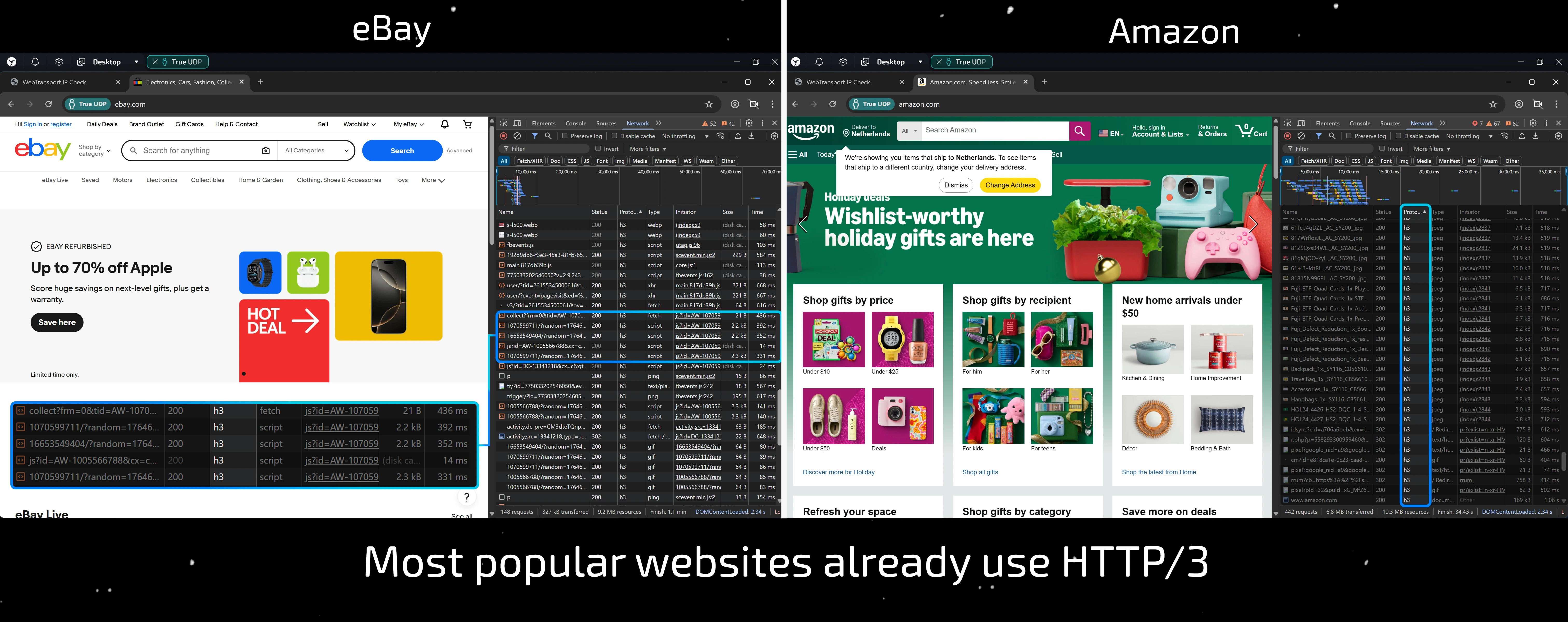
If you see h3—it means the connection to the site is via the HTTP/3 protocol. As you can see, this is not an experimental technology, but a standard that works on your computer right now.
Ask yourself: if your home browser opens these sites via h3, but your work profiles in the anti-detect browser use only h2 or http/1.1—how natural does that look to anti-bot systems?
Technical Requirements for Proxies
For your traffic to meet modern standards, it is not enough to simply "enable" UDP support in the browser. It is critically important that every link in the network chain—from your ISP or VPN to the final proxy server—correctly handles this protocol. If even one node blocks or does not understand UDP, the magic will not work. And here we run into the fundamental limitations of the proxy types themselves.
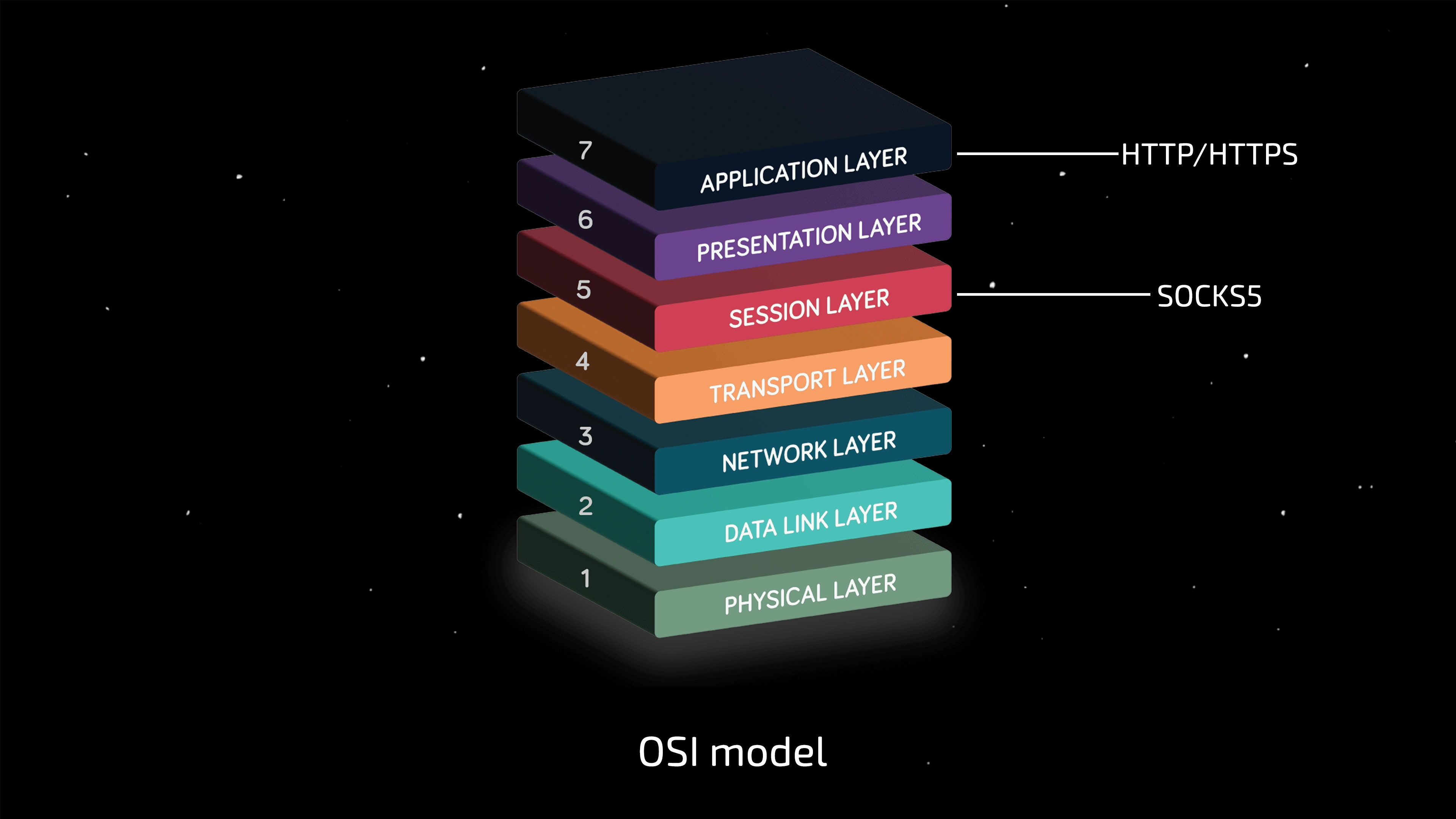
There are two main connection standards on the market: HTTP(S) and SOCKS5. Let's figure out which one is capable of what by looking at the OSI model (the basic model of open systems interconnection).
HTTP/HTTPS: A Technical Dead End for UDP
HTTP is an application layer protocol (Layer 7, the highest level of the OSI model). It was created for a specific task: transferring hypertext, web pages, images, and API requests.
As a transport, HTTP historically and technically uses only TCP.
If you bought an HTTP or HTTPS proxy, there will never be UDP support there. This is a limitation of the standard itself. Even if the proxy service claims "high speed," you will not be able to establish a QUIC connection or correctly process WebRTC via UDP through an HTTP proxy. The browser will be forced to use TCP, which, as we found out above, is a trigger for user verification systems.
SOCKS5: The Universal Tunnel
SOCKS (Socket Secure) is a session layer protocol (Layer 5 of the OSI model). It works lower than HTTP and does not try to interpret the data passing through it. It is simply a tunnel for traffic.
SOCKS5 was originally designed as a universal proxy protocol. It knows how to work with both TCP and UDP. However, it is important to understand the difference between the protocol's capabilities and its implementation.
The fact that the SOCKS5 standard allows working with UDP does not guarantee its presence on a specific server. Implementing UDP support requires additional resources and configuration on the proxy provider's side, and today, far from all services are ready to provide this option.
For the correct operation of modern web protocols, only SOCKS5 proxies are suitable for you. When choosing a provider, be sure to clarify the availability of UDP traffic support, as many popular services have this functionality disabled by default or missing altogether.
How to Implement UDP Support in Work?
Suppose you have the right SOCKS5 proxies with UDP support. How do you force the anti-detect browser to use this potential? Today there are two common paths.
Method 1: External Proxification (The Hard Way)
If the browser itself does not know how to work with UDP inside SOCKS5 (and this, unfortunately, is the standard for most solutions on the market), users have to resort to additional routing tools—external proxifiers.
This is implemented by configuring the entire operating system or router to work through a proxy.
Tools usually involve expensive solutions based on Raspberry Pi or industrial routers with appropriate functionality (you can read more about setting up via a router in our article about Keenetic).
However, this approach has a number of disadvantages:
- One session for the entire device. You wrap all the computer's traffic in a proxy. This makes it impossible to work with 10, 50, or 100 profiles simultaneously.
- Instability. Your entire system becomes dependent on one proxy. If it "drops," the internet disappears everywhere.
- Parasitic traffic. Windows updates, background services, and messengers will start updating through an expensive residential proxy, leading to traffic overruns and reduced speed.
Method 2: Native Browser Support (The Ideal Scenario)
The most effective and technological approach is to use an anti-detect browser that knows how to natively process UDP traffic inside the SOCKS5 protocol. In this case, support is implemented at the level of the software's network engine itself, without the need for third-party tricks.
This removes all limitations of external proxifiers:
- Scalability. You can work with dozens and hundreds of profiles simultaneously. Each profile maintains its independent connection with its unique proxy, which is critically important for multi-accounting.
- Isolation and Stability. Proxying occurs strictly inside the browser container. System traffic does not mix with work traffic, and the failure of one proxy does not affect the operation of other profiles and the operating system.
- Full Network Stack. Technically, the correct implementation of UDP transport is a necessary condition for the operation of all new generation protocols: HTTP/3, QUIC, WebTransport, and full-fledged WebRTC. The browser gains the ability to behave naturally, establishing connections just like a regular Chrome on a home PC.
But here a logical question arises: is it enough to simply declare UDP support in SOCKS5? Does this automatically guarantee that all complex protocols (like QUIC) will work correctly and the trust system will see a natural fingerprint? Or can technical nuances hide behind loud statements, nullifying all anonymization efforts?
To sort this out, we conducted our own technical market research. We checked how popular solutions actually handle UDP traffic, and whether this function really provides the advantages expected from it. The results turned out to be quite revealing.
Research — UDP Proxy Support in Anti-Detect Browsers
The market for anti-detect browsers is huge, but when it comes to real innovations, the circle narrows down to a few. We were surprised by the audit results: despite the critical importance of UDP for the modern web, native support for this technology (without complex manipulations and external programs) is offered by only two products on the market—Linken Sphere and Vision.
However, as our testing showed, claiming support and implementing it fully are two different tasks.
In this section, we will not only show the results but also give you the tools so you can independently check any browser.
Testing Methodology
To ensure the picture was objective, we checked not only the fact of connection but also the operation of all modern protocols dependent on UDP.
Our test stand:
- SOCKS5 Proxy: The same private proxy with guaranteed UDP support was used.
- Tools: A set of independent checkers for WebRTC, QUIC, and WebTransport.
- Participants: Linken Sphere, Vision, and, for the purity of the experiment, a hardware Keenetic router (as a benchmark for an external proxifier).
How to Check Your Anti-Detect Browser?
- Preparation: Create a profile and specify a SOCKS5 proxy. Important: make sure your proxy provider supports UDP, and the browser interface (if such a feature exists) displays the corresponding indication.
- Testing: Sequentially visit the 4 resources from the list below.
- Analysis: Compare what you see with our interpretation of the results.
Step-by-Step Breakdown of Test Metrics
We selected 5 tests that show different levels of network operation—from basic WebRTC to advanced HTTP/3.
1. Twilio (WebRTC Test)
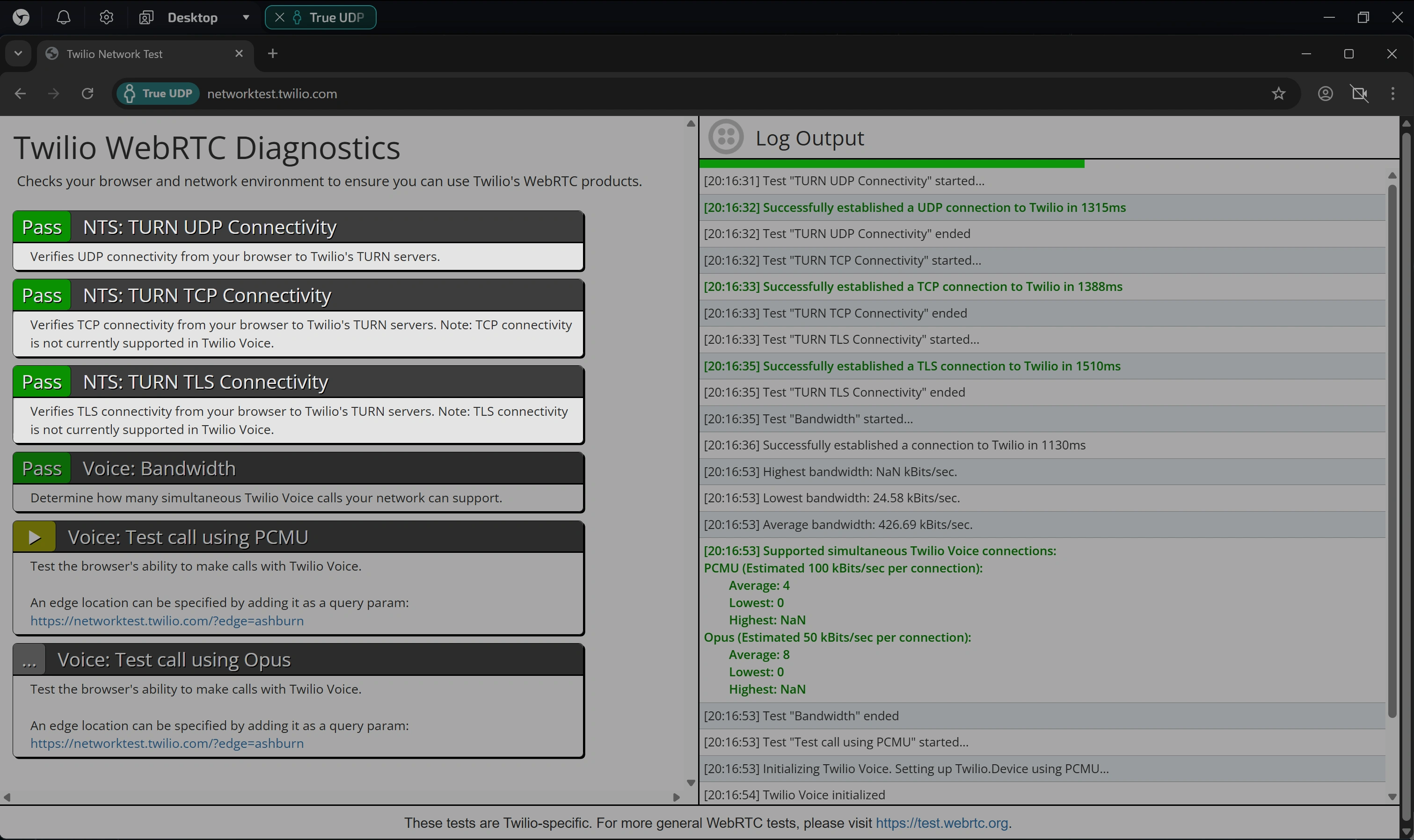
Link: networktest.twilio.com
This test checks if the browser can establish audio/video communication.
- What to look for: We are interested in the result of the NTS: TURN UDP/TCP/TLS Connectivity tests.
- Good result: Green "Pass" labels next to all three items. This means WebRTC is fully functional.
- Bad result: The appearance of red "Fail" labels next to any of the items (UDP, TCP, or TLS) signals problems with establishing a connection and partial inoperability of the entire technology.
2. IPbinding (Leak Check)
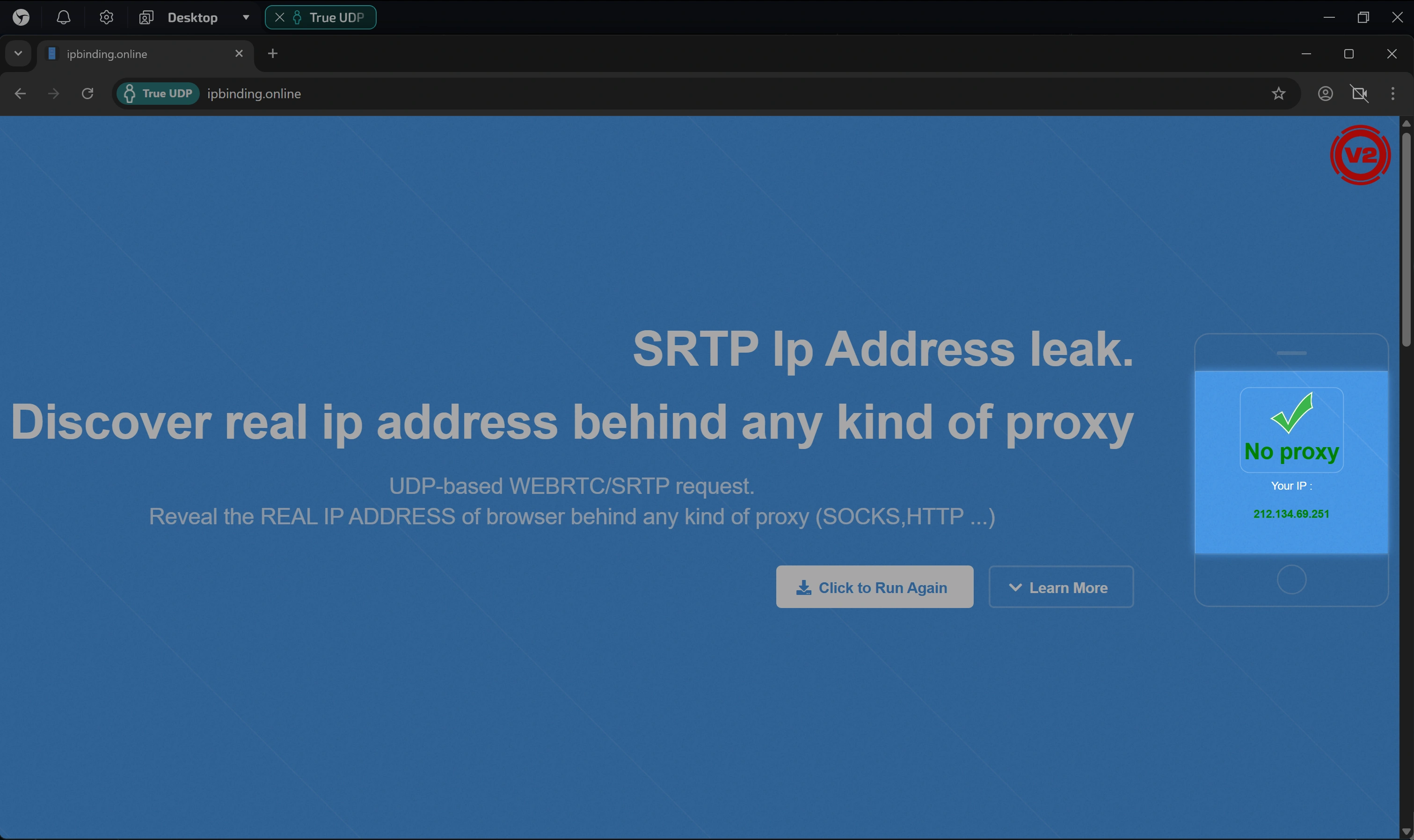
Link: ipbinding.online
The test initiates a connection to a TURN server for a practical check of WebRTC operation and obtaining your IP address.
- What to look for: The IP address in the results.
- Good result: The displayed IP matches your proxy IP.
- Bad result: You see your real IP (leak) or endless loading (connection is blocked).
3. Cloudflare QUIC (HTTP/3 Test)
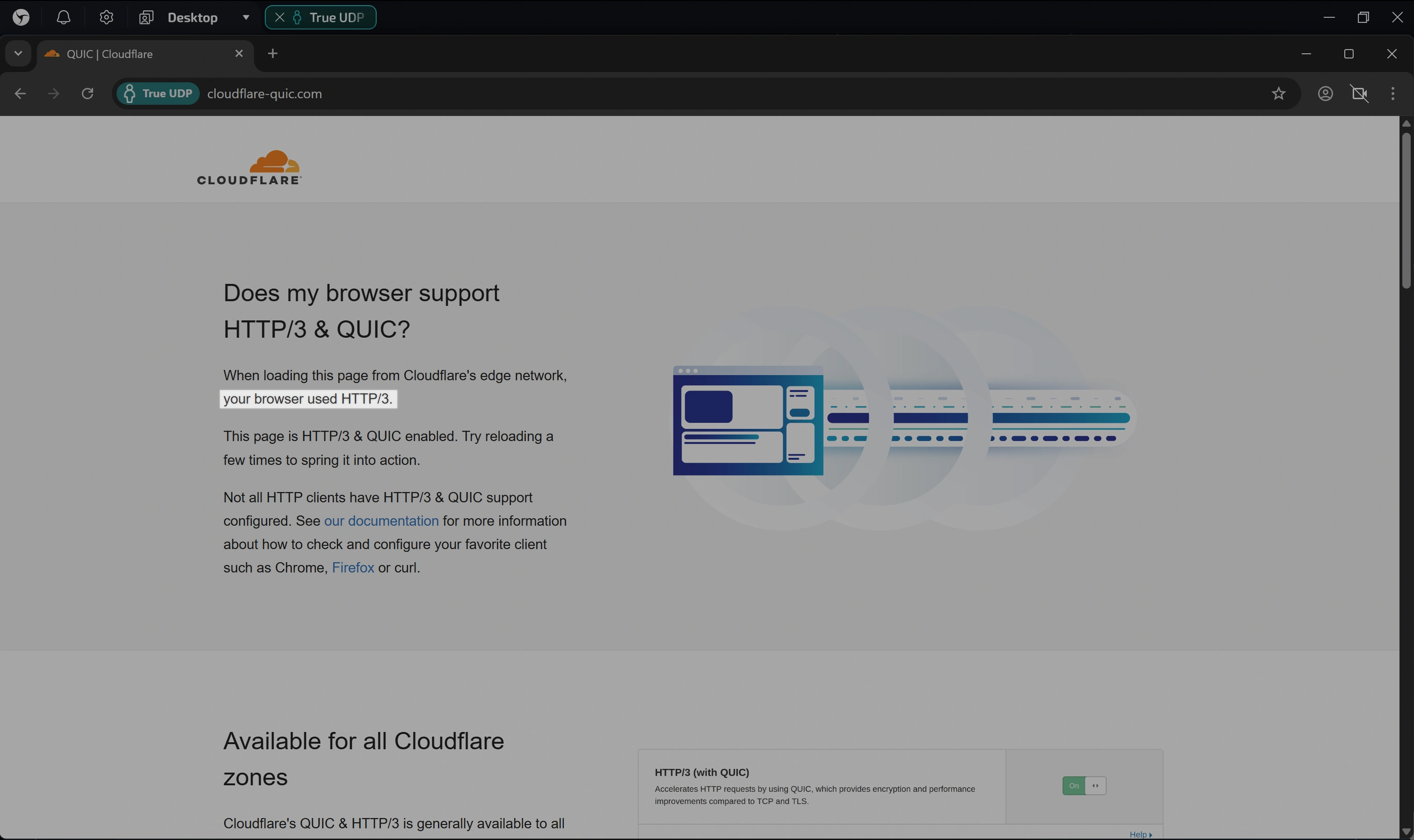
Link: cloudflare-quic.com
Here begins the most interesting part. Many browsers know how to route WebRTC via UDP but continue to load sites via old TCP. This test shows if QUIC is working for you.
- Feature: Refresh the page several times. Browsers often try TCP first, and only after receiving the
Alt-Svcheader do they switch to HTTP/3. - Good result: Text: "your browser used HTTP/3".
- Bad result: Text "your browser used HTTP/2". This means the browser cannot use the high-speed protocol, even if the proxy allows it.
4. WebTransport (Modern API Check)
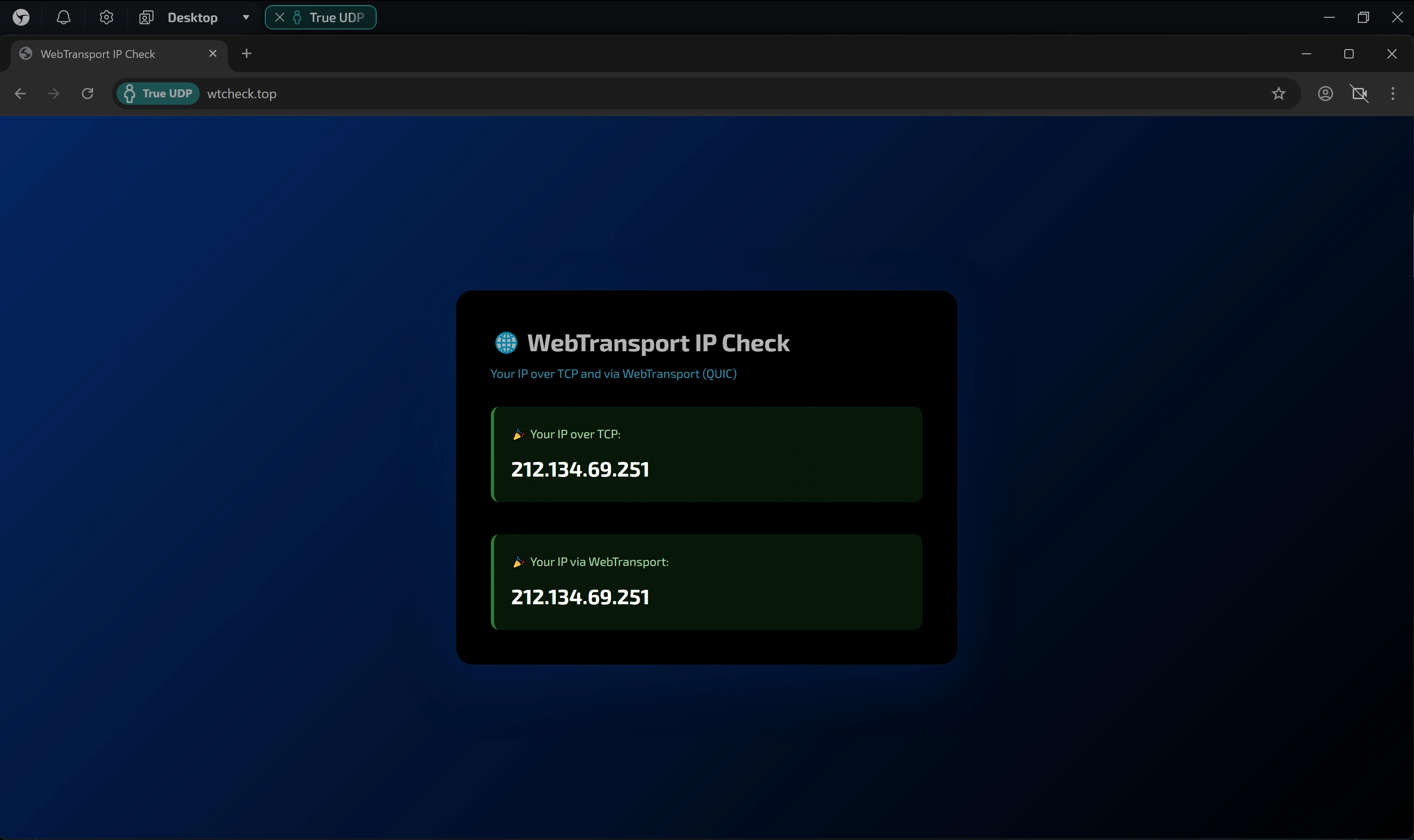
Link: wtcheck.top
WebTransport is a next-generation technology that architecturally cannot function without the QUIC protocol (and, consequently, without UDP). Its operability is one of the markers of a full network stack implementation.
- Good result: The test displays two blocks with IP addresses (for TCP and WebTransport), and both match your proxy address.
- Bad result: The appearance of a
WebTransport error. This unequivocally indicates that UDP support in the browser is missing or implemented only partially.
Results of Our Research
Support |
Linken Sphere 2 v2.11.12 |
Vision v3.3.38 |
Keenetic Speedster |
|---|---|---|---|
| WebRTC (Video/Audio) TURN (Twilio) | |||
| WebRTC (Video/Audio) SRTP (IPbinding) | |||
| HTTP/3 & QUIC (Cloudflare) | |||
| WebTransport (wtcheck) | |||
| Multi-threading (Different IPs in different profiles) | |||
| Final Rating | 5 | 3 | 2 |
We conducted a series of tests using the same SOCKS5 UDP proxy. The results clearly show the difference between partial and full implementation of UDP support.
Vision — The Problem of Partial Support
Vision demonstrates partial implementation. The WebRTC protocol indeed works via UDP, but the main web traffic (page loading, requests to modern web infrastructure) continues to go through the outdated TCP (HTTP/2).
This creates a contradictory network profile: the browser demonstrates the capabilities of a modern communication channel when working with media, but forcibly degrades to outdated protocols during regular surfing. For security systems, such a discrepancy looks like a technical anomaly.
Keenetic Speedster — External Proxification
Using an external proxifier (in this case, a Keenetic Speedster router) demonstrates results similar to partial software implementation. The device successfully handles UDP forwarding for WebRTC, but, like Vision, does not ensure the operation of HTTP/3 & QUIC for main web traffic by default.
The main disadvantage of this method is the lack of multi-threading. The router wraps the entire traffic of the connected device into a tunnel. This makes simultaneous work with multiple profiles impossible: you are limited to one active session per physical connection, which critically reduces work efficiency in multi-accounting.
Linken Sphere — Network Consistency
In Linken Sphere, full UDP support is implemented. Instead of point-to-point forwarding of the popular WebRTC, we made it possible to work with all modern technologies inside the SOCKS5 tunnel. This allows the browser to use the transport protocol as intended by Chrome developers, without artificial limitations.
In practice, this ensures:
- Network Consistency: Absence of logical gaps where different types of traffic are forced to use different transport protocols.
- Native HTTP/3 Operation: Interaction with Google, Meta, and a significant part of the global web (more than 36% of sites from the top 10 million) occurs via the QUIC protocol, which is the standard for the vast majority of real devices.
- Support for Next-Gen Network APIs: Technologies like WebTransport work "out of the box," ensuring the correct execution of modern scenarios.
Conclusion
As the results of our research showed, declared UDP support in product specifications does not always mean correct operation of the network stack in practice. In conditions where the web is rapidly moving to HTTP/3, partial implementation of protocols creates an incomplete digital profile that is easily detected by modern security systems.
Linken Sphere remains the only solution on the market today offering truly full UDP support. We have bridged the technological gap between emulation and reality, allowing your profiles to interact with Google, Facebook, and other giants in the language of modern high-speed protocols.
We believe that quality spoofing is a basic right, not a premium option. Therefore, native UDP support is available to Linken Sphere users on any plan, including the completely free plan (Free). Download the browser, set up a proxy, and verify the connection quality yourself.
P.S. For developers of other solutions
We strive for maximum objectivity. If you represent another anti-detect browser and are confident that your product also provides native UDP support, write to us. We will gladly conduct repeat tests and update our research. The market should know its heroes.