Free Proxies — 7 Verified Sites

Free proxies are almost always associated with risks. They are often overloaded, work unstably, and quickly lead to bans. At the same time, you do not know who controls the server and what is happening with your traffic. Therefore, such solutions are suitable only for simple tasks and should not be used where data security is important.
In this material, we will consider whether it is safe to use free proxies, in which cases they are permissible, and also analyze 7 sites with open lists of IP addresses.
Can You Use Free Proxies
In most cases, free proxies are not suitable for work tasks. Public IPs quickly lose reputation, regularly end up on blacklists, and are restricted by services. High load on such nodes leads to reduced speed and connection instability.
An additional risk is related to security: the user does not control the infrastructure and cannot verify whether traffic collection and analysis is being conducted. Therefore, free proxies are not used for working with multi-accounting, advertising systems, payment services, corporate resources, and other tasks where data protection and access stability are critical.
Nevertheless, free proxies are permissible in limited scenarios. They can be used for one-time bypassing of blocks, technical testing without authorization, and other tasks not related to the transmission of confidential data.
When choosing a free proxy, it is desirable to use services that publish IP check results — the time of the last test, availability status, and connection latency. It is also important to consider the frequency of proxy database updates, since outdated IPs quickly stop working or get blocked. If such data is missing, you will have to check functionality yourself via a proxy checker or manually.
7 Sites with Free Proxies
In this selection, we have collected various services with free proxies: from simple tables to catalogs with advanced filtering.
ProxyScrape
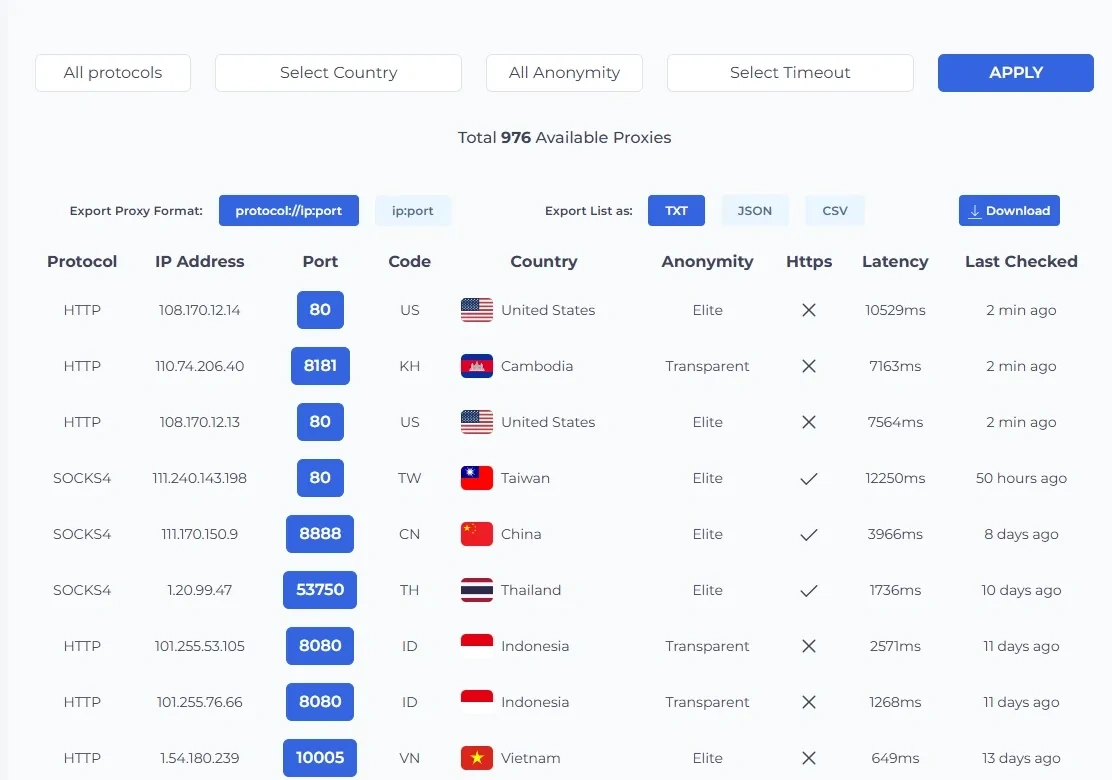
ProxyScrape — an international service with free HTTP, HTTPS, SOCKS4, and SOCKS5 proxies. It specializes in publishing open proxy databases that can be used without registration or payment. The site aggregates thousands of IP addresses from different sources and updates lists in real-time, providing access to different types of proxies.
Key features:
- Open proxy lists by type
- Filtering by country and anonymity level
- Ability to download proxies in TXT format or retrieve via API
- Regular database updates and list exports
- Simple interface with the ability to select parameters before downloading
FreeProxyLists
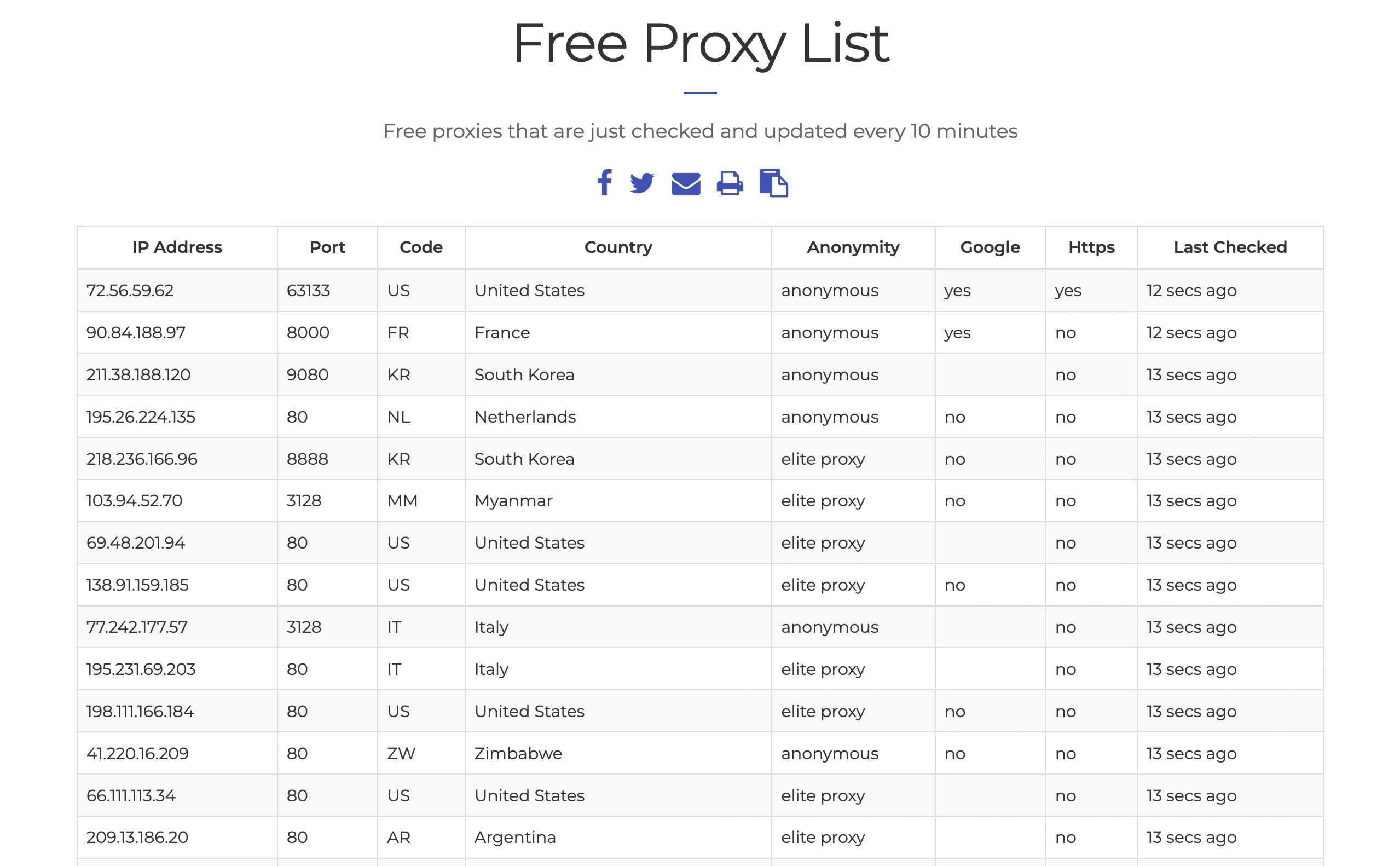
FreeProxyLists — a public database of free HTTP and HTTPS proxies. The main page features a table with current IP addresses, which updates automatically every 10 minutes. The list simultaneously offers from several hundred to over a thousand proxies depending on the current database update. Access is open without registration.
Key features:
- Display of IP address and port
- Indication of country and country code
- Display of anonymity level (elite proxy / anonymous)
- Google support (yes / no)
- HTTPS support (yes / no)
- Display of last check time (Last Checked)
- Sortable table with dynamic data updates
ProxyDB
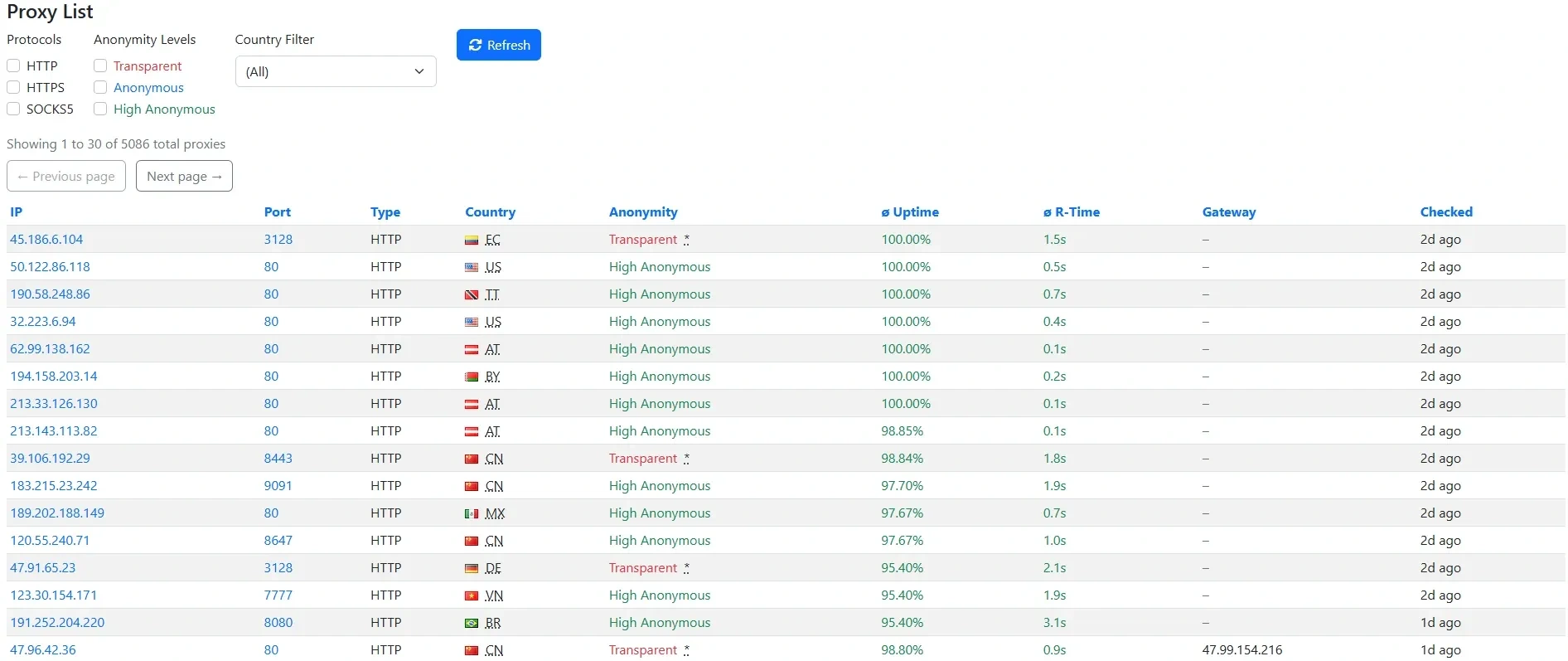
ProxyDB — an online catalog of free proxy servers with filtering by protocols and countries. The site displays a table with current IP addresses and general statistics on the number of available proxies (for example, at the time of publication, 5088 options are available).
Key features:
- Table with IP addresses and ports
- Support for HTTP, HTTPS, and SOCKS5 protocols
- Filtering by country
- Filtering by anonymity level
- Minimalist interface — the table is displayed immediately on the main page
Spys.one
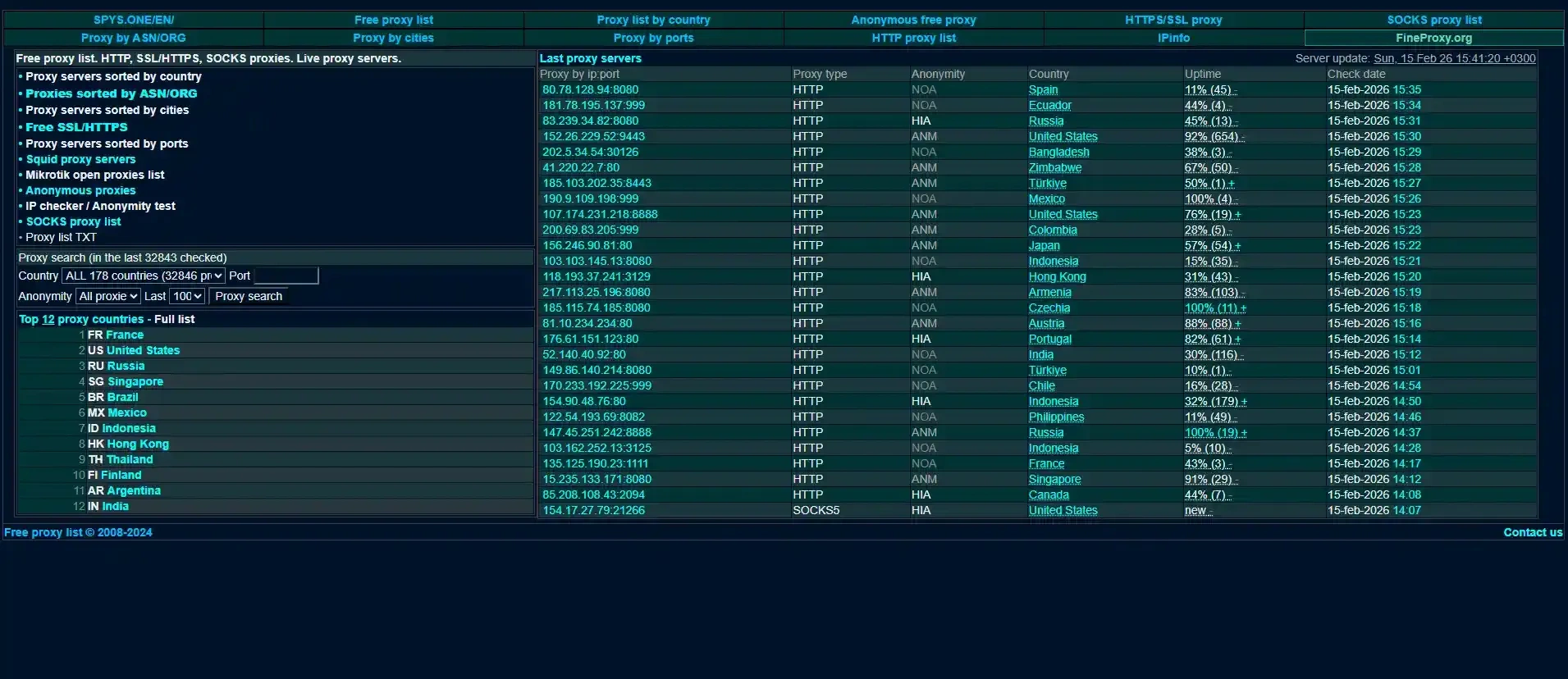
Spys.one — a large catalog of free proxies with an advanced filtering system. The ALL proxies section simultaneously displays more than 30,000 proxies from different countries.
Key features:
- Selection of proxy type (HTTP, HTTPS, SOCKS4, SOCKS5)
- Separate sections by countries and categories
- Advanced filtering before displaying the list
- Display of speed, uptime, and date of last check
- Getting the list in TXT format via a separate page
- Pagination for working with a large volume of the database
- The Spys.one interface is a data-heavy table with advanced filters
Gather-Proxy
Gather-Proxy — is a public service with free proxies. At the time of publication, the site presents over 10 thousand addresses.
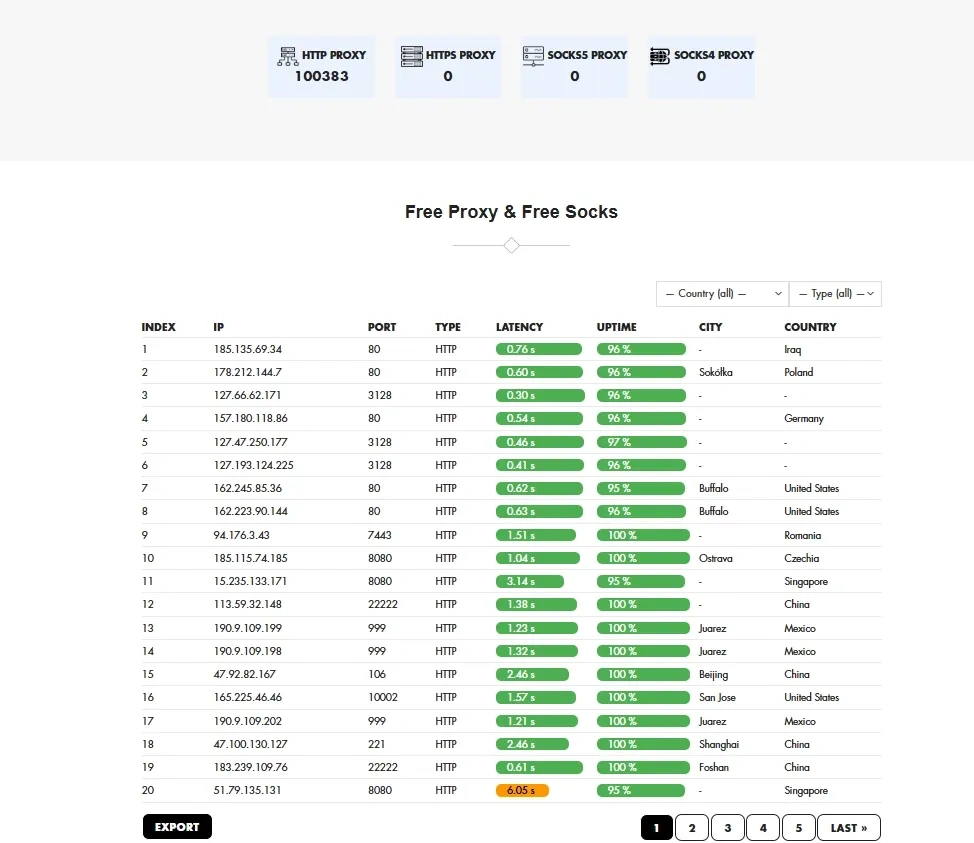
Key features:
- Filter by country and proxy type
- Display of latency in seconds with color indication
- Display of uptime percentage for each IP
- Export button to download the current list
- Pagination through the database
- Interface convenience — the proxy table is placed on the main page under commercial blocks
Geonix
Geonix — a service with a free proxy database featuring HTTP/HTTPS and SOCKS4/5 servers. The database counts more than 3000 records broken down by country, type, and anonymity level, which can be filtered and downloaded.
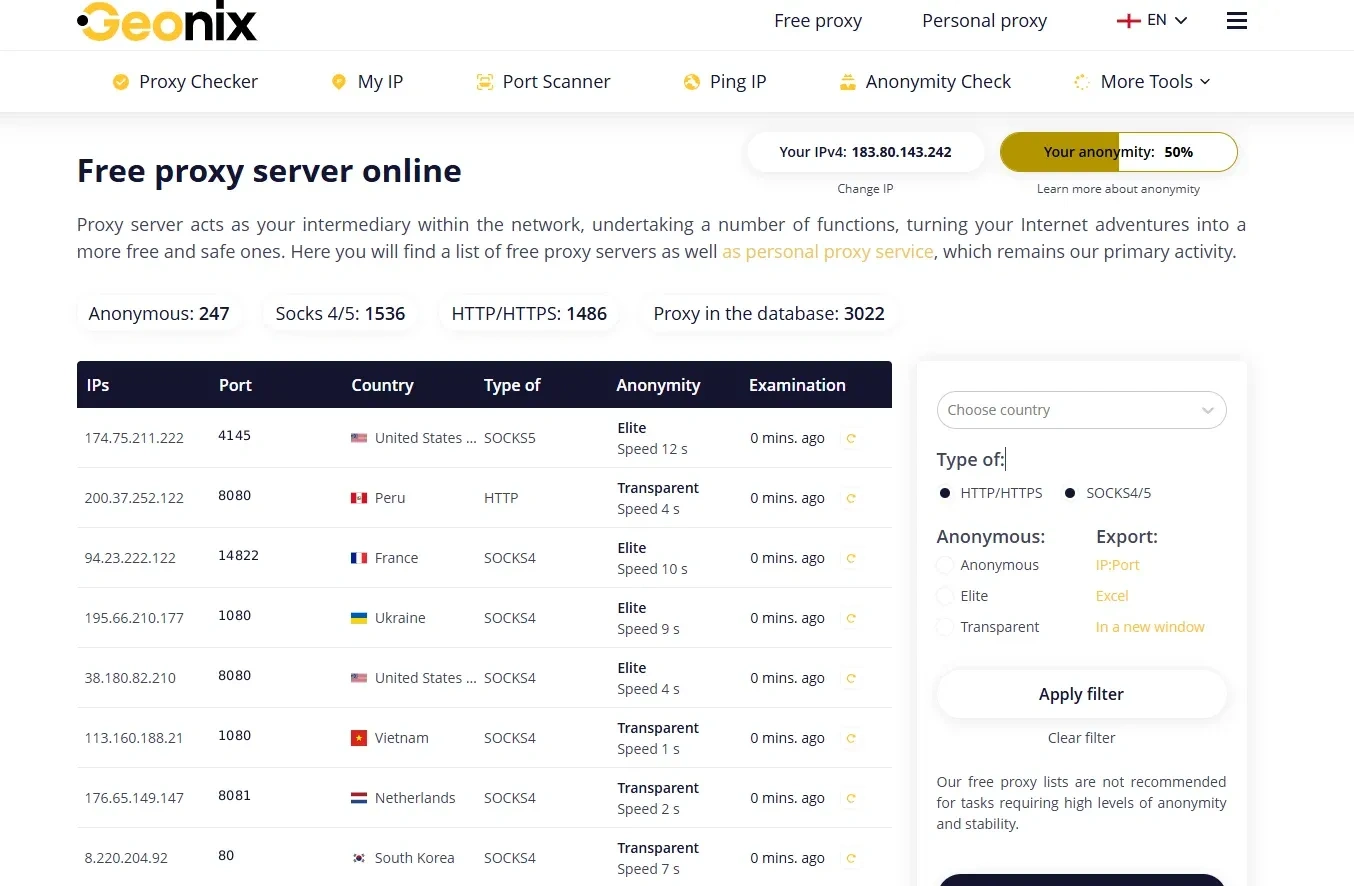
Key features:
- Filtering the list by country and protocol type (HTTP/HTTPS or SOCKS4/5)
- Selection of anonymity level (Anonymous / Elite / Transparent)
- The table updates dynamically and shows latency (Latency) for each IP
- Export list in IP:Port or Excel format
- There is a separate proxy checker
- The interface is simple and convenient — the section with free proxies is moved to a separate page of the service
- Navigation through pages of a large list.
ProxyNova
ProxyNova — a site with a list of open proxies that updates every 60 seconds. The table displays checked proxies indicating speed and time of the last check.
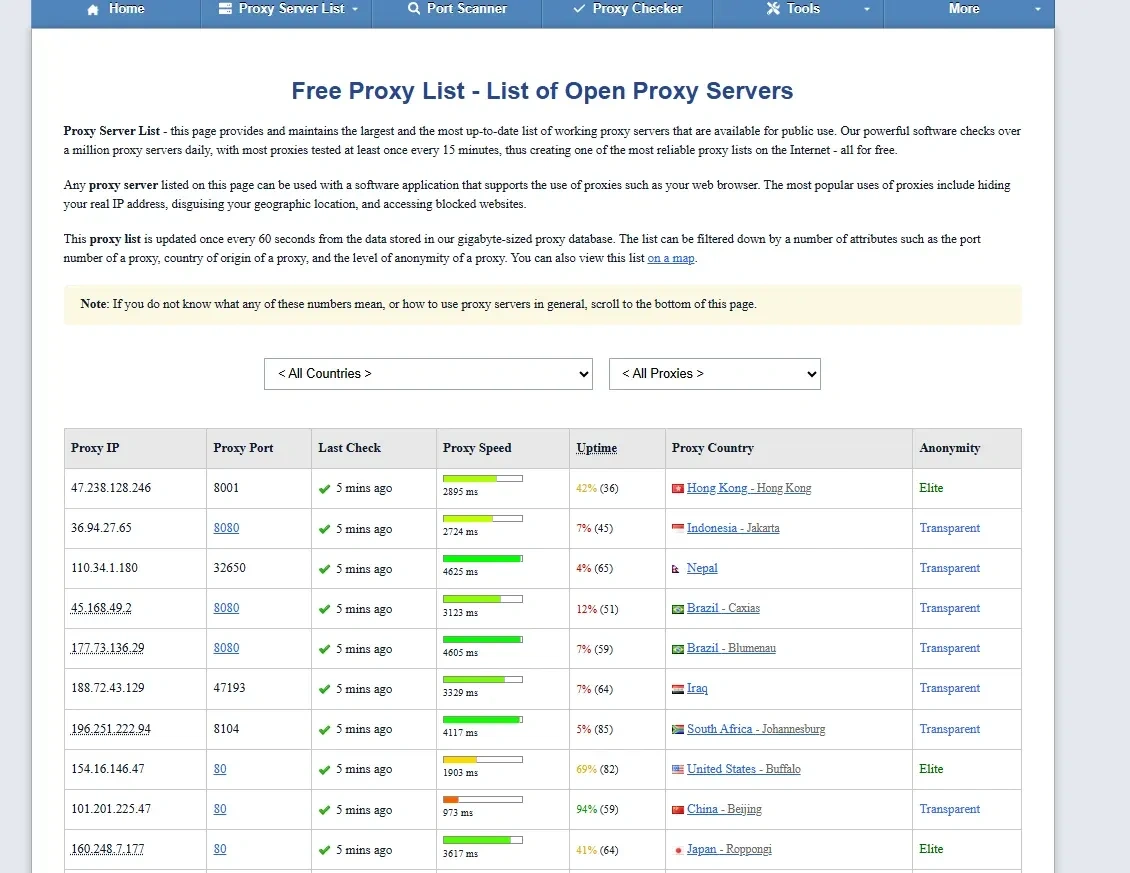
Key features:
- List of free proxies, sorted by time of last check
- Filtering by country and proxy type via dropdown lists
- Time of last check for each IP
- The interface is built around a large table with filters above the list; speed and uptime indicators are visually highlighted
Tips for Safe Use of Free Proxies
Free proxies require a cautious approach. Even when used for simple tasks, it is important to follow basic safety rules to reduce the risks of blocking and data leakage:
-
Use free proxies only for non-critical tasks
Such proxies are suitable for one-time tests or bypassing blocks, but not for working with accounts, advertising cabinets, or payment services where stability and data preservation are important.
-
Regularly check the functionality and status of the proxy
Free IPs quickly fail or end up on blacklists, so they need to be tested via a proxy checker or manually before use. It is also desirable to check connection speed and response time.
-
Do not transmit confidential information through free proxies
Do not use them for logging into online banking, corporate systems, and other services where passwords, payment data, or personal information are entered.
-
Check the reputation of the service publishing the proxy list
Before using, it is worth looking at how long the domain has been running, whether the site has public contacts and a privacy policy, and whether it is mentioned on specialized forums or in discussions.
Conclusion
Free proxies remain an accessible tool for one-time tasks, but in most cases, they are not suitable for stable and safe work. Public IPs are quickly blocked, connection speed is unstable, and the level of data protection cannot be verified. The user essentially hands over their traffic to a third party without guarantees of confidentiality.
Using free proxies is permissible only for non-critical scenarios — testing without authorization or short-term bypassing of GEO restrictions. For working with accounts, advertising systems, financial services, and any sensitive data, such solutions are not suitable.
If speed, stability, and information protection are important, it is wiser to choose proven paid services.
Frequently Asked Questions
Free proxies are public IP addresses used simultaneously by dozens or hundreds of people. They do not guarantee stability, speed, or privacy, often get blocked, and come with no technical support. Paid proxies typically provide dedicated or semi-dedicated IPs, ensuring higher speeds, connection stability, and transparent terms of service.
The easiest way is to use a proxy checker or specialized software to test the IP and port. You can also manually configure the proxy in your browser and open any website to verify connectivity. Additionally, it is worth checking the response time and confirming that your real IP address is hidden using IP lookup services.
Generally, no. Free proxies have high latency and unstable connections, which is critical for real-time gaming. Furthermore, gaming services often block public proxy IPs.
A VPN encrypts all internet traffic and usually offers a more stable connection. Unlike a VPN, a free proxy most often works only for specific applications or browsers and does not guarantee data protection. If security and stability are important, a VPN is usually preferable.